The message walks in almost every week at every serious BJJ academy in the country. Some version of: “I’ve been thinking about training for years, but I’m probably too old now.”
The person sending it is 32. Or 41. Or 55. Or 63.
And the answer is always the same, and it is always true: you are not too old. You are, in fact, right on time. Adults who start Brazilian Jiu Jitsu later in life often become better long-term students than the teenagers who grew up in the sport, because you show up with patience, discipline, and a real reason to be there.
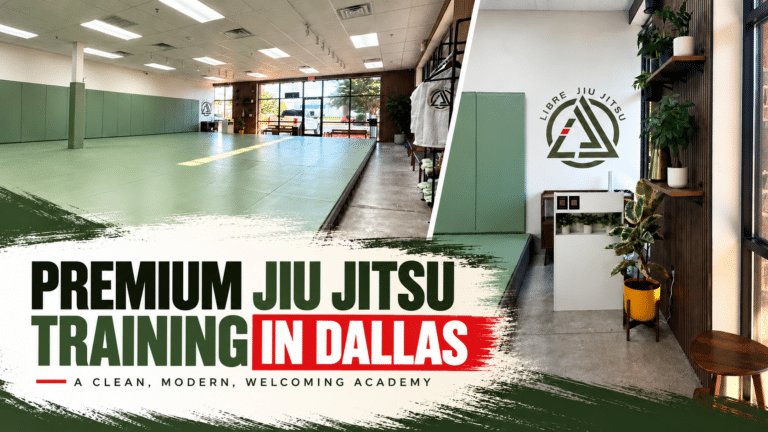
This is a long, honest look at what starting jiu jitsu as an adult actually looks like: the real fears (with real answers), the physical adjustments that matter, the timeline of your first month, and what to expect at every age bracket from 30 to 60 plus. If you have been searching BJJ near me from anywhere in Farmers Branch, Carrollton, or Addison, or typing BJJ in Dallas into a browser tab you keep telling yourself you’ll act on next week, this article is written for you. We will also cover our free trial BJJ Dallas week at Libre Jiu Jitsu, which lets you test the water for seven full days at no cost so you can see for yourself, no pressure, no contracts, no salesperson breathing down your neck.
The Big Lie That Keeps Adults Off the Mat
Here is the myth: to be good at a martial art, you have to start young.
It is not true. It has never been true. And the belief that it is true has kept more capable, motivated adults away from Jiu Jitsu than any other single factor.
The reality is that Brazilian Jiu Jitsu was designed from the ground up to reward technique over athleticism. The Gracie family who developed the sport built it specifically so that smaller, older, or physically weaker practitioners could defeat larger, younger, stronger opponents. That entire premise is engineered around the exact kind of person who worries they might be starting too late.
Most world-class black belts you have ever heard of did not grow up training. Many of them started in their mid-20s or later. Plenty of active blue and purple belts today started in their 40s. There are 60-year-olds earning their black belts right now in academies across the country. The idea that “your window closed” is marketing invented by sports where reflexes matter more than principles. Jiu Jitsu is not one of those sports.
Your window has not passed, the time is now.
What Age Actually Means in BJJ (An Honest Look)
Age changes what training looks like. It does not change whether training is possible.
A 22-year-old and a 52-year-old can both start Jiu Jitsu on the same day, take the same class, and both walk out feeling the same success. They will progress at different rates in certain ways: the 22-year-old will recover faster from hard rounds, the 52-year-old will retain techniques better because they focus more intently. Both are valid paths. Neither is “worse.”
Here is what actually changes with age in BJJ:
- Recovery time gets longer: A hard training session at 45 takes longer to bounce back from than the same session at 25, and that is completely normal. With consistency your recover time will get shorter and shorter.
- Injury risk shifts: You will bounce off aggressive movements less easily.
- Sleep and hydration matter more: Skipping either one hits harder the older you get.
- Learning speed does not decrease: Contrary to popular belief, older adults absorb technical detail faster because they focus better and ask more questions.
- Consistency becomes more important than intensity: Two well-recovered classes a week for a year beats four exhausted classes a week for a month.
What does not change: your ability to learn, your ability to improve, your ability to hold your own against athletic training partners once you know what you are doing, and your ability to become genuinely skilled at a martial art you love.
The 5 Fears That Keep Adults From Starting (and the Honest Answer to Each One)
Every hesitant adult beginner is dealing with some combination of these five specific fears. Here is each one, called out by name, with a real response.
Fear 1: “I’m Too Old”
The average age of new students at a well-run academy is somewhere between 30 and 45. You will not walk in and be the only person over 25. You will walk in and find a room full of people your own age, plus a handful who are older than you and doing just fine. The “too old” narrative dissolves the moment you see the actual room.
At any age from 18 to 65, you can learn the sport, improve at it, and get real benefit from it. Beyond 65 is possible too with the right coach and the right approach, though the training pace shifts more significantly. Below 65, age is essentially a non-factor for whether you can start.
Fear 2: “I’m Out of Shape”
This is the second-most common fear and it is almost always wrong. Jiu Jitsu will get you in shape. Nobody starts in great shape unless they were already an athlete. Everyone gets winded in their first month. Everyone is sore for the first two weeks. Everyone survives it and comes back.
The academy is not a gym where fit people work out. It is a training environment where people learn a skill that happens to also build fitness. You do not need to “get in shape first.” That is a delay tactic your brain uses to keep you comfortable. The gym is where the fitness gets built, not something you have to earn before you show up.
If you are genuinely worried about your baseline conditioning, ask a coach at your visit. A good coach will suggest starting with two classes a week, taking breaks during rounds when needed, and pacing yourself. Nobody expects you to keep up with an experienced blue belt in your first month.
Fear 3: “I’ve Never Done a Sport or Martial Art in My Life”
This is a strength, not a weakness.
People with no prior martial arts background often progress faster in BJJ than people who spent 10 years in another style. There is nothing to unlearn. You do not carry over habits from Karate or Taekwondo or Boxing that need to be corrected. You are a clean slate, and clean slates are easy to build good technique on.
A brand new student with zero athletic history, training two to three times per week, will feel competent in fundamentals inside three months. Inside a year, they will be surprising themselves.
Fear 4: “I’ll Get Hurt”
Jiu Jitsu has one of the lowest injury rates of any full-contact activity because there is no striking. You will not be punched, kicked, or hit. Most injuries in BJJ are small: bruises, sore muscles, tweaked fingers, occasional joint discomfort. Serious injuries do happen but they are rare, and almost all of them come from either aggressive training partners (which a good academy screens for) or ignoring the “tap early” rule (which every new student is taught immediately).
You are safer on a Jiu Jitsu mat under a competent coach than you are on a jogging path in most neighborhoods. That is not marketing. It is documented. The Consumer Product Safety Commission’s injury data has consistently shown grappling arts to have lower rates of serious injury than running, cycling, and most team sports.
Fear 5: “I’ll Embarrass Myself”
You will feel awkward. Everyone does. For the first month, your body will not do what you want it to. You will get tangled up. You will forget the sequence you were just shown. You will tap out to people half your size. All of this is normal, and all of it is what training partners expect from a beginner.
Here is the truth about the “embarrassment” fear: nobody in the training room is judging you. Every single person there was once a beginner. Every single one of them remembers being exactly where you are. The culture of a good academy is genuinely, unmistakably supportive. You will feel awkward. You will not be embarrassed. There is a difference, and you will only find that difference by walking in the door.
Starting in Your 30s, 40s, 50s, and Beyond: What’s Actually Different
Different age brackets bring different realities. Here is what to expect and adjust for at each stage.
Starting in Your 30s
The 30s are arguably the best decade to start BJJ. Your body is still recovering well, you have adult patience and focus, you have income to afford good training, and you likely have enough life experience to appreciate why the sport matters. Almost every professional black belt teaching today at your local academy either started in their 30s or wishes they had.
Physical adjustments to make: Warm up more thoroughly than a 20-year-old would, prioritize sleep on training nights, treat protein and hydration as non-optional. Otherwise train like anyone else.
Expected timeline: Fundamentals feel comfortable at three months, you can hold your own against untrained partners at six months, blue belt is typically achievable in two to three years with consistent training.
Starting in Your 40s
Starting in your 40s is completely normal at any serious academy. You will find plenty of peers. What changes: recovery takes noticeably longer between hard sessions, you will feel connective tissue (elbows, knees, shoulders) more than you did at 25, and you will need to be more thoughtful about training frequency.
Physical adjustments: Two to three classes a week is the sweet spot for most 40-plus beginners. Add a strength and mobility routine on off days. Communicate injury history to your coach on day one. Be willing to tap early during rolls. Nobody is impressed by pain tolerance, and everyone is impressed by long-term consistency.
Expected timeline: Fundamentals at three to four months, real competency at nine to twelve months, blue belt in two to three years. The path is the same as your 30s, just with more emphasis on recovery.
Starting in Your 50s
Absolutely doable. You will not be alone. The 50-plus BJJ community is growing everywhere, including across the Farmers Branch and North Dallas area.
Physical adjustments: Build up training volume more slowly. Consider starting with one class a week for the first month, adding a second in month two. Focus on flow-oriented rolling rather than intense competition-style rounds. Choose training partners deliberately: skilled higher belts who know how to control intensity are much better rolling partners than aggressive white belts trying to prove themselves.
Expected timeline: Fundamentals at four to six months, real competency at 12 to 18 months, blue belt in three to five years. It takes longer but the destination is exactly the same.
Starting in Your 60s and Beyond
This is where individual factors matter most. Your general fitness, injury history, and mobility all play larger roles than they do at younger ages. But it is entirely possible. There are 70-year-old blue and purple belts training multiple times a week. The right coach will build a training path that works for your body.
Physical adjustments: start with a private session or two before joining group classes so a coach can assess your baseline and design a plan. Choose an academy known for its ability to work with mature students, and specifically ask how they handle older beginners. Avoid academies that treat every student the same regardless of age. That approach fails older adults quickly.
Expected timeline: Highly individual. Focus on the joy of the training, the community, and the health benefits rather than any particular rank timeline.
Your First 30 Days: What Actually Happens
Here is the honest week-by-week breakdown of what most adult beginners experience in their first month.
Week 1
You show up. You are nervous. The coach walks you through a warmup that seems complicated. You partner with somebody experienced who is patient and slow. You drill a few basic techniques and feel completely uncoordinated. You are exhausted after 45 minutes.
You leave the mat feeling awkward but relieved that nobody laughed at you. Your muscles ache in specific places you did not know you had.
Week 2
Second class. The warmup feels less confusing. You start to recognize a few positions. Your first roll (if you choose to do one) lasts three minutes and feels like an hour. You get tapped out four times and never once felt like you knew what was happening. You survive it. You feel weirdly proud.
Soreness peaks this week. Some new students quit here because their body hurts. If you make it through, you have crossed the hardest bridge.
Week 3
Things start to click. You recognize positions faster. Your body is adjusting to the physical demands. The people you train with know your name. A coach corrects you on something specific during drilling and it makes sense. You are less exhausted at the end of class.
You notice you slept better last night than you have in weeks.
Week 4
You feel like a beginner instead of an intruder. Techniques you drilled two weeks ago show up in your rolls without you thinking about them. You defend a submission successfully for the first time. You get tapped out less often. You laugh during class.
You have officially become a Jiu Jitsu practitioner. The beginning of your Jiu Jitsu training starts here.
The 6 Adjustments Adult Beginners Should Make
Six specific things that will save you months of frustration if you build them in from the start.
1. Train two to three times per week, not more: More is not better in your first six months. Your body needs recovery time. Two consistent classes a week for a year beats four inconsistent classes a week for three months.
2. Tell your coach your injury history on day one: Bad back, bad knee, previous shoulder surgery, whatever it is. A good coach adapts the training. A great coach uses this information to keep you on the mat for years instead of weeks.
3. Tap early and tap often: Never let ego keep you in a submission. Every experienced grappler taps hundreds of times per year. Tapping is not losing. Refusing to tap is how you end up injured.
4. Choose training partners deliberately: As a new adult student, prioritize rolling with experienced belts (blue, purple, brown, black) who know how to control intensity. Avoid ego-heavy white belts trying to prove themselves. A good coach will help you find the right training partners.
5. Sleep and hydrate like it’s part of the training: Because it is. Your recovery on training nights is what determines whether you show up on the next training day.
6. Focus on principles, not techniques: In your first six months, do not try to collect fancy submissions. Focus on the fundamentals: posture, base, distance, framing, breathing. These principles will carry every technique you ever learn. Everything else is decoration.
What Adult BJJ Classes Look Like at a Good Academy
A well-run adult BJJ class runs 60 to 90 minutes. It usually opens with a warmup (movements to loosen up hips, shoulders, and neck), moves into technique instruction (coach demonstrates, students drill in pairs), progresses through positional training (starting from a specific position and working out of it), and often ends with optional rolling (practice sparring against a resisting partner). Jiu jitsu for beginners over 30 looks essentially the same, just with a bit more warmup and a bit less ego.
Adult BJJ classes at a serious academy include:
- Fundamentals-focused instruction where coaches actually teach, not just perform.
- Both Gi and no-gi grappling across the weekly schedule so you get exposure to both formats.
- Mixed skill levels where experienced students help beginners rather than smash them.
- Coach supervision during rolls so intensity stays controlled and beginners are protected.
- A no-ego culture that starts at the top and is enforced consistently.
You should never feel intimidated in an adult BJJ class. You should feel challenged, welcomed, and slightly out of your depth in the best possible way.
Brazilian Jiu Jitsu for beginners Dallas seekers can find real, structured, adult-focused training locally. Farmers Branch martial arts options along the I-35E corridor include academies built specifically around the adult beginner experience, ours included, and searching adult BJJ Farmers Branch will surface the small handful of academies actually running dedicated adult programs in the area.
The Hidden Advantages Adults Have Over Younger Beginners
Here is what nobody tells you: starting BJJ as an adult comes with real, measurable advantages that younger beginners simply do not have.
Patience: Adults do not need instant gratification. You understand that skill takes years. Kids and teenagers often quit when progress feels slow. You keep showing up.
Focus: When a coach explains a technique, you actually listen. You take notes mentally. You ask thoughtful questions. Teenagers zone out and copy what their partner does. Guess who learns faster.
Discipline: You know how to build a habit. You know how to prioritize a training day even when you would rather stay home. Discipline is the single strongest predictor of long-term BJJ success, and adults have far more of it than younger beginners.
Life context: You know why you are training. Maybe it is stress relief. Maybe it is fitness. Maybe it is self-defense Dallas parents wanted their kids to have and now you want it for yourself. Whatever the reason, you have a reason. That drives consistency.
Financial stability: You can afford good training, quality gear, and physical therapy or massage when your body needs it. Young beginners often cannot.
Better questions: Coaches will tell you privately that adult students ask the best questions. Kids ask “when do I get my next belt.” Adults ask “why does this hip movement matter.” One of those questions leads somewhere.
Common Excuses (and Why They Don’t Hold Up)
The five fears above are the big ones. Here are the smaller excuses that adults use to delay starting, along with why each one is really just fear in disguise.
“I’ll start next month when things settle down.” Things will not settle down. Life is always full. The people training every week are just as busy as you. They found the time. So can you.
“I need to lose weight first.” No, you don’t. Training will help you lose weight. Waiting to lose weight before training is the exact opposite of how the math works.
“I want to join with a friend.” Almost every adult student walked in alone the first time. You will make friends fast, so waiting for someone else to commit is unnecessary and often permanent.
“Let me research more academies first.” After a couple of sessions of research, the time spent digging deeper could have been spent in the jiu jitsu studio with us learning. If you have found two or three good options, pick one, take the free trial, and decide from experience instead of from reviews.
“I’ll wait until after the holidays.” The holidays are always coming. This one is a classic. Start now, take a week off if you need to, and be ahead by January instead of just starting.
Ready to Try? What Your First Visit Should Look Like
Here is exactly how a good first visit should go:
- You call ahead or book online to say you want to try a class.
- A coach welcomes you when you arrive and shows you the training area, changing space, and where to leave your shoes.
- You are introduced to a few training partners who will be looking out for you during the session.
- You participate in warmups and drilling at whatever pace works for you. Nobody expects perfection.
- You are given the option to observe or participate in rolling at the end of class. Total beginners often watch first, join later. Both are fine.
- A coach checks in with you after class to see how you felt and answer questions.
- Nobody pressures you to sign up on the spot. A good academy trusts that if the experience was right, you will come back.
If your first visit checks these boxes, you are at a good academy. If it does not, keep looking.
What Comes Next
To read a full walkthrough of what your first day feels like from the moment you walk in, check our detailed piece on what your first Jiu Jitsu session actually feels like. Not sure what to bring or wear? Here is our practical guide on what to wear to your first class.
Women considering starting alongside adult mixed classes can read our detailed look at women stepping onto the mat across North Dallas and what specifically makes women’s programs different.
Our flexible BJJ memberships come in monthly, three-month, and six-month options with honest cancellation terms, and our full weekly class schedule shows exactly when adult classes run so you can plan around your workweek.
If you want to experience it from the inside first, join our adult BJJ classes and Brazilian Jiu Jitsu training in Farmers Branch through our free trial week. No commitment, no pressure.
Frequently Asked Questions
Is it too late to start Jiu Jitsu at 40?
No. 40 is a completely normal age to start BJJ. Most academies have multiple students in their 40s. You will find peers, and you will progress well with the right training approach.
What if I’ve never done any sport or martial art before?
That is often an advantage, not a disadvantage. You come in with no bad habits to unlearn. Coaches build your foundation from scratch, which is easier than reworking somebody’s Karate-influenced defensive stance.
Can I start Jiu Jitsu if I’m out of shape?
Yes. The training will get you in shape. Waiting to get in shape before starting is the exact wrong order. Start now at whatever fitness level you have, and let the training do its work.
How often should an adult beginner train?
Two to three times per week is the sweet spot for most adult beginners. More than that in your first six months often leads to overtraining, injury, or burnout.
Will I get injured?
Small tweaks and bruises are normal. Serious injuries are rare, especially at academies that take culture and coaching seriously. Injury rates in BJJ are much lower than in running, cycling, or most team sports.
What’s the difference between adult jiu jitsu classes Dallas academies offer versus kids classes?
Adult classes go deeper technically, roll harder (when both partners agree), and cover a wider range of positions and submissions. Kids classes focus more on movement, discipline, and age-appropriate techniques. The overlap is real but the training environments are quite different.
Can I try before committing?
Yes. Libre Jiu Jitsu offers a full free trial week with access to any class on the schedule, including all adult BJJ classes, women’s classes, and open mat time. No credit card required, no pressure to sign up after.
Where are you located?
We are located at 13150 Senlac Dr Ste 190, Farmers Branch, TX 75234, right off I-35E at Valley View Lane. Reach us at (972) 587-0488.
Your Window Is Right Now
The best time to start Jiu Jitsu was 10 years ago. The second-best time is this week.
The truth is that adults who start at 30, 40, 50, or 60 do not regret starting. They regret waiting so long. The one thing you cannot get back is the year you spent thinking about it instead of doing it.
Our free trial week exists exactly for the person who has been on the fence for months. Seven days of full access to adult BJJ classes, women’s sessions, Gi, and no-gi grappling training, at zero cost and zero commitment. Come try one class. Come try five. Come figure out from actual experience whether this sport belongs in your life.