You get off work at five. Maybe six. You are tired, your brain is fried, and the couch is calling. The last thing you feel like doing is putting on workout clothes and driving somewhere to sweat.
And yet, the people who train Brazilian Jiu Jitsu after work will tell you the same thing: the version of yourself that walks off the mat at 8 PM is a completely different person than the one who dragged themselves out of the office at 5:30. Clearer. Calmer. Physically spent in the good way. The kind of tired that actually leads to sleep instead of the restless, screen-glazed exhaustion that comes from doing nothing after doing everything all day.
If you’re looking for evening Jiu Jitsu in Dallas, the hard part isn’t deciding it’s worth it. The problem is building the consistency that turns “I should go” into “I just go.” That is a scheduling problem, a habit problem, and an energy management problem, and this post addresses all three.
Libre Jiu Jitsu runs adult classes every weekday evening at our Farmers Branch location, just off I-35E and Valley View Lane. We also offer a free trial week so you can test the schedule before committing. No guesswork, no obligation.
Why After-Work Training Hits Different
There is something about training Jiu Jitsu in the evening that separates it from every other post-work activity most adults try.
Going to a conventional gym after work is fine. It burns calories. It moves your body. But your brain can still wander. You can run on a treadmill while replaying a bad meeting. You can lift weights while composing a passive-aggressive email in your head. The mental channel stays open even when the physical one is active.
BJJ closes that channel completely.
When you are rolling, you are not thinking about your inbox. You are not thinking about tomorrow’s deadlines. You are not thinking about anything except the person in front of you who is actively trying to control your body.
Training partners who roll after their workday consistently describe the same experience: they walk in carrying the day’s tension in their shoulders, their jaw, their lower back. They leave having shaken all of it loose. Not because they ignored the stress, but because the training demanded so much cognitive and physical engagement that the stress literally could not compete for their attention.
This is not meditation. This is not yoga. This is problem-solving under physical pressure, and it works as a stress release in a way that passive recovery activities often do not.
The Real Reason Most Adults Struggle With Consistency
Let’s be honest about what actually stops working professionals from training consistently. It is rarely the physical difficulty of the training. It is the logistics around the training.
The Decision Fatigue Problem
Every evening, you face a decision: train or skip. And decision fatigue, after a full day of making choices at work, makes the “skip” option sound incredibly reasonable. You are tired. The drive feels long. You did not eat lunch properly. You promised yourself you would go tomorrow instead.
This is not a willpower failure. It is a design problem. If your training schedule requires a fresh decision every single evening, you will eventually lose that battle.
The fix is removing the decision. You do not decide whether to go. You decide when you go, and you go on those days unless something genuinely prevents it. The training schedule becomes a fixed appointment, not a daily negotiation.
The Commute Problem
For working professionals in Dallas, the commute between the office and the gym can feel like a barrier. But the commute to Libre Jiu Jitsu from most North Dallas, Carrollton, and Addison locations is straightforward. Our Farmers Branch academy sits right off I-35E and Valley View Lane, which means you can reach us from most parts of the North Dallas area in under 20 minutes during typical evening traffic.
Plan your route. Pack your bag the night before. Put it in your car before you leave for work. When the workday ends, drive directly to the academy. Do not go home first. Going home first is where consistency goes to die. Your couch is a gravity well. Once you sit down, the odds of leaving again drop dramatically.
The Energy Problem
“I am too tired after work to train.”
This is the most common excuse, and it is almost always wrong.
What you are experiencing at 5:30 PM is not physical exhaustion. It is mental fatigue from a day of cognitive work. Your body has been sitting in a chair for eight hours. It has energy. It just does not feel like it because your brain is running on fumes.
BJJ fixes this. That is exactly why BJJ classes after work are so effective: the first five minutes on the mat are the hardest. After that, the warm-up wakes your body up, the drilling engages your motor system, and by the time you start rolling, the desk-day fog has burned off completely. Most evening practitioners report feeling more energized after class than before it, not less.
The trick is getting through the door. Once you are on the mat, the training takes over.
Building a Training Schedule That Sticks
Consistency in BJJ is not about training every day. It is about training on a predictable schedule that your life can absorb without breaking.
How Many Days Per Week?
Two classes per week is the minimum for consistent progress. At this frequency, you retain what you learned from session to session, your body adapts to the physical demands, and your skill development moves forward.
Three classes per week is the sweet spot for most working adults during their first year. This gives you enough mat time for real improvement while leaving recovery days between sessions. Three consistent days per week for a year produces more progress than five days per week for three months followed by burnout and a long break.
Four or more is for experienced practitioners who have dialed in their recovery, nutrition, and sleep. If you are just starting, three is plenty. Do not over-commit and under-deliver. Commit to a number you can actually sustain.
Choosing Your Days
Look at the Libre Jiu Jitsu class schedule and pick your days based on two criteria: which days fit your work schedule most naturally, and which days give you adequate recovery between sessions.
Our weekly schedule runs:
- Monday: 5:00 to 9:00 PM
- Tuesday: 4:15 to 9:00 PM
- Wednesday: 5:00 to 8:00 PM
- Thursday: 4:15 to 9:00 PM
- Friday: 5:00 to 8:00 PM
- Saturday: 12:00 to 2:00 PM
A strong three-day schedule for a working professional might look like Monday, Wednesday, and Friday. Or Tuesday, Thursday, and Saturday. The alternating-day structure gives your body a rest day between sessions, which is critical during your first few months when your body is adapting to new physical demands.
If two days per week is your reality right now, Tuesday and Thursday or Monday and Wednesday work well. Consistency on two days beats inconsistency on four.
Not sure which days will work? Use your free trial week to try a couple of different evenings before you pick.
Lock It In Your Calendar
This sounds basic, but it changes behavior. Put your training sessions in your calendar as recurring events. Block the time. Treat them the same way you would treat a meeting with a client or a doctor’s appointment.
When a colleague asks if you are free on Tuesday evening, the answer is no. You have a commitment. The fact that your commitment involves wearing a gi and getting choked by a friend does not make it less of a commitment.
The After-Work Routine That Makes Training Automatic
Here is a concrete system that working professionals at our academy use to train consistently after work without it feeling like a battle every single day.
The Night Before
Pack your bag: Gi, rash guard, shorts, mouthguard, water bottle, any post-training snack. Set it by the door or put it in your car.
Set your training clothes out: If you are going to change at the academy, your training gear is in the bag. If you are going to change at the office before you leave, set those clothes where you will see them.
Pre-plan your post-work snack: Eating a heavy meal right before training will slow you down. Going in with nothing in your stomach since lunch will leave you drained halfway through the warm-up. The sweet spot is a moderate snack about 60 to 90 minutes before class: a banana and peanut butter, a handful of trail mix, a protein bar. Prep this the night before so it is in your bag or your car, not something you need to hunt for when you are already tired and running late.
During the Workday
Do not make an evening decision: The training was decided last night when you packed the bag. Today’s only job is to follow the plan.
Block transition time: If class starts at 5:30, plan to leave work by 5:00 so you have time to drive and change without rushing. Build this into your workday. Leave early enough that arriving at the academy feels calm, not frantic.
Eat your pre-training snack: Around 4:00 PM, eat what you packed. This gives your body 60 to 90 minutes to process before class starts.
The Drive
Drive to the academy. Do not go home first. This is the single most important logistics decision. Going home means sitting down, changing into comfortable clothes, and getting absorbed in something that makes the drive back out feel impossible. Drive directly from work.
After Class
Enjoy the feeling: The post-training state, physically tired but mentally clear, is one of the best feelings available to an adult with a full-time job. You earned it. Let it settle.
Eat a real meal: After training, your body needs protein and carbohydrates to recover. Have a plan for dinner that does not involve making a complicated decision while you are tired and hungry. Meal prep on Sundays helps. A simple, protein-rich dinner after class supports recovery and makes the next training day feel better.
Sleep: BJJ practitioners consistently report sleeping better on training days. The combination of physical exertion and mental engagement produces a quality of sleep that passive rest cannot match. Capitalize on this. Go to bed at a reasonable hour and let your body recover.
What Happens When Life Disrupts Your Schedule
It will happen. A work deadline extends past your class time. A family obligation lands on a training day. You get sick for a week. Travel takes you out of town.
The question is not whether your schedule will get disrupted. It is how you respond when it does.
Rule One: Missing One Day Is Fine. Missing Two in a Row Is Dangerous.
One missed session is a blip. Two missed sessions in a row is the beginning of a pattern. When you miss a day, make a plan for the next one immediately. Do not leave it open. Open-ended breaks from training tend to extend themselves.
Rule Two: Adjust the Schedule, Do Not Abandon It
If a recurring obligation makes your usual training day impossible, swap it for another day that week instead of just skipping. The goal is maintaining your weekly training count, not rigidly adhering to specific days.
Your schedule at Libre Jiu Jitsu gives you six days of options. If Wednesday is off the table this week, move that session to Thursday or Saturday. Flexibility within the framework of consistency is the key.
Rule Three: Communicate With Your Training Partners
One of the underrated benefits of training at an academy is that people know when you are not there. If you are going to miss a stretch of sessions due to travel or work, tell your training partners or your coach. This does two things: it keeps you socially accountable because now other people expect you back, and it removes the awkwardness of returning after a break because everyone already knows why you were gone.
Rule Four: Restart Without Guilt
If you fall off for two weeks or a month, do not spend energy beating yourself up about it. Just go to the next class. The mat does not care about your attendance record. Your training partners are glad to see you regardless of how long it has been. The only bad response to a break is making it a longer break.
The Mental Health Case for Evening BJJ
The mental health benefits of training after work deserve their own section because they are often the real reason people stay.
The Brain Reset
Your brain after a full workday is not resting. It is running low-grade stress cycles on repeat: unfinished tasks, unanswered messages, interpersonal friction from a meeting, vague anxiety about tomorrow. Sitting on the couch does not stop these cycles. It gives them free rein to loop.
BJJ interrupts the loop by demanding complete cognitive presence. There is no bandwidth left for background stress when someone is trying to pass your guard. The result is that you leave the mat with a genuinely cleared mental state, not just a distracted one.
The Confidence Carryover
The confidence that comes from regular BJJ training is functional, not abstract. You know you can handle physical discomfort because you have done it. You know you can stay calm under pressure because you have rolled while tired, while losing, while a more experienced partner applied pressure you did not know how to escape.
That composure carries over directly into your professional life. Working adults who train consistently report handling workplace pressure with more steadiness, approaching difficult conversations with less anxiety, and recovering from setbacks faster.
The Social Connection
For adults whose social lives have narrowed to coworkers and family, an evening BJJ class provides something most people are missing: a community of people who share a challenging pursuit, push each other to improve, and form friendships through shared effort.
These are not casual gym acquaintanceships. Grappling with the same people three times a week builds trust, familiarity, and connection in a way that working out near someone on parallel treadmills never will. Your training partners become friends. Your coach becomes a mentor. The academy becomes a place you belong to, not just a place you visit.
Fitting BJJ Into a Family Schedule
If you have kids, a partner, or both, training after work involves more than just your own logistics. It involves coordinating with the people who are counting on you to be home.
Talk to Your Family About the Schedule
Before you commit to specific training days, have an honest conversation with your household about which evenings are realistic. If Tuesday and Thursday are family dinner nights, do not sign up for Tuesday and Thursday classes and then feel guilty every week. Pick the days where training fits without creating friction.
Combine Training With Kids’ Activities
At Libre Jiu Jitsu, we run kids martial arts classes alongside our adult programming. Some families train at overlapping times, which means you get your session in while your child gets theirs. This turns BJJ night into family activity night rather than a night where one parent disappears.
Frame It as Health Maintenance, Not a Hobby
When your partner sees your BJJ training as something that makes you a better, calmer, healthier version of yourself, it shifts from “time away from the family” to “maintenance that benefits the family.” Because it is. The stress relief, the sleep improvement, the physical fitness, and the emotional regulation that come from consistent training make you a better parent, partner, and professional.
What About Morning Training?
Some people are morning trainers. They prefer to get their session in before work, arrive at the office already accomplished and clear-headed.
Morning training works for some schedules, but most BJJ academies, including Libre Jiu Jitsu, focus their programming on evenings because that is when the majority of working adults are available. The density of training partners is higher in the evening, which means more variety in rolling, better drilling partnerships, and a more energized room.
That said, there is no wrong time to train. When people ask about the best time to train BJJ, the honest answer is the time you will actually show up. If mornings are your only realistic option and you find a class that fits, take it. But for most Dallas-area professionals, evening BJJ classes align better with the structure of the workday and the availability of training partners.
How Long Until Training Feels Like Second Nature?
Three to four weeks.
That is how long it takes for most working adults to shift from “forcing myself to go” to “this is just what I do on Mondays and Wednesdays.” The first two weeks feel like a battle of willpower. By week three, the routine starts to carry its own momentum. By week four, skipping feels weirder than going.
The key is not to evaluate the commitment during those first two weeks. You are building a habit, and habits feel effortful at the start. That effort is normal and temporary. Push through it, and the other side is a training schedule that sustains itself.
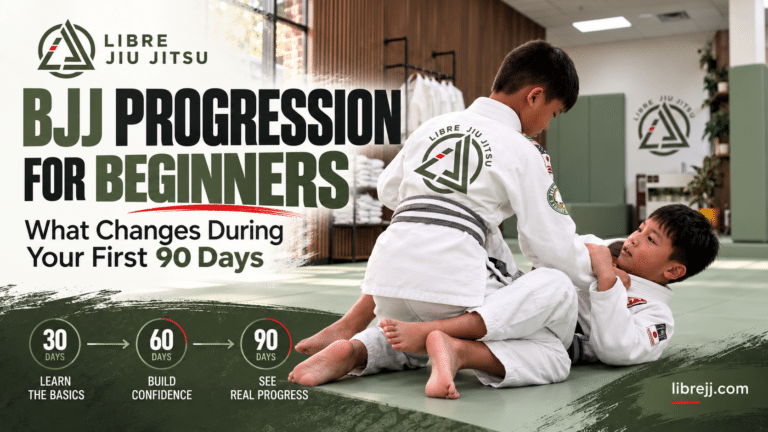
If you are curious about what the first 90 days of training actually look like skill-wise, our post on BJJ for beginners: your first 90 days covers it month by month.
Frequently Asked Questions
How late do evening Jiu Jitsu classes run?
At Libre Jiu Jitsu, weekday classes run as late as 9:00 PM on Monday, Tuesday, and Thursday, and as late as 8:00 PM on Wednesday and Friday. Saturday training runs from 12:00 to 2:00 PM. This range gives you flexibility to arrive after work even if your day runs long. Check our full class schedule for specific class times and program breakdowns.
Can I train BJJ if I have never done any martial art before?
Absolutely. Most of our adult students started with zero martial arts experience. The fundamentals curriculum is designed for complete beginners. Your coaches will walk you through every technique, pair you with appropriate training partners, and scale the intensity to your level. No background required.
How many days per week should I train if I work full-time?
Two to three days per week is ideal for working adults, especially during the first year. Two days maintains consistent progress. Three days accelerates it. More than three per week can lead to recovery issues that slow your development rather than speed it up. At Libre Jiu Jitsu, our schedule runs six days a week, so finding two to three sessions that fit is straightforward.
What if I am exhausted after work and do not feel like training?
Go anyway. Seriously. The fatigue you feel after a desk job is mental, not physical. Your body has been sitting all day. It has energy. The first five minutes on the mat will shake the fog loose, and by the time rolling starts, you will feel more alive than you have all day. The worst classes are the ones you almost skipped.
Do I need to eat before an evening BJJ class?
Yes, but lightly. A moderate snack 60 to 90 minutes before class gives you fuel without weighing you down. A banana, a protein bar, a handful of nuts, something with carbohydrates and a bit of protein. Do not train on a full dinner. Do not train on an empty stomach since lunch. Find the middle ground and prep the snack the night before.
What should I bring to evening class?
Your gi (or athletic wear if you do not have one yet), a water bottle, a mouthguard once you start rolling, and a clean change of clothes for the drive home if you prefer. Most people pack everything the night before and leave the bag in their car so the after-work transition is seamless.
Your Evening Starts on the Mat
You spend eight or more hours a day giving your energy to work. You owe yourself something back.
Evening Jiu Jitsu isn’t just another workout. It’s how a lot of our members get their evenings back. A version of your evening that ends with you sleeping better, thinking clearer, and carrying yourself with a confidence that no treadmill or dumbbell rack has ever produced.
Our evening Jiu Jitsu classes at Libre Jiu Jitsu are built for working professionals in Farmers Branch, Carrollton, Addison, and North Dallas who want to take back their evenings. We offer flexible BJJ memberships that fit your budget and your schedule, and a free trial week so you can test the routine before committing.
Book your free trial week at Libre Jiu Jitsu in Farmers Branch. We’re at 13150 Senlac Drive, Suite 190, right off I-35E and Valley View Lane. Call us at 972-587-0488.