Most women who walk into a Brazilian Jiu Jitsu academy for the first time are a little nervous and full of questions. Will I be the only woman in the room? Do I need to be athletic already? Will it hurt? Is this really for someone like me? Those questions are normal, and the honest answers are reassuring: no, you will not be alone for long, no, you do not need to arrive fit, and the training is far more controlled and welcoming than the word “fighting” suggests.
Here is the bigger truth that brings women back week after week. Jiu Jitsu is the rare physical discipline built specifically so that a smaller, lighter person can control a larger, stronger one using technique and leverage instead of raw power. For most women, that is not a small detail. It is the entire point.
This guide explains, in plain terms, why women should train jiu jitsu: the mechanical reasons it works for smaller bodies, what it gives you in real self-defense, the fitness and confidence that follow, and the community that keeps women on the mat for years. If you are anywhere in Dallas, North Dallas, Farmers Branch, Carrollton, or Addison, this is for you.
At Libre Jiu Jitsu, located right off I-35E and Valley View Lane in Farmers Branch, we run women’s jiu jitsu classes for complete beginners every week. If you have searched BJJ near me or Brazilian Jiu Jitsu for beginners in Dallas and felt unsure whether a Farmers Branch martial arts gym was for you, start with a no-pressure free trial and decide for yourself. By the end of this article you will understand exactly what you would be walking into, and why so many women never look back.
The Core Idea: Leverage Beats Size and Strength
Brazilian Jiu Jitsu is often called “the gentle art,” and there is a reason. It is a grappling system, not a striking one. There is no punching and no kicking. Instead, you learn to control another person’s body through position, leverage, angles, and timing.
That design is why it works for women in a way that few other martial arts do. Strength still helps, but technique reliably overcomes a strength and size advantage. A woman who trains consistently can learn to control and submit a partner who outweighs her significantly, not because she got stronger than him, but because she learned to apply force where the human body is weak and to neutralize force where it is strong.
Three pieces of the puzzle matter most for a smaller body.
Learning to Fight From Your Back
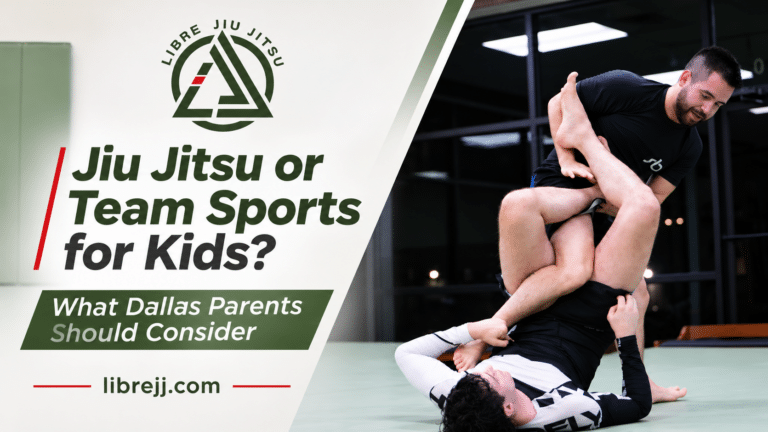
Jiu Jitsu is famous for teaching people to be dangerous from their back, through a family of positions called “the guard.” This sounds counterintuitive (being on your back feels like losing), but it is precisely the skill a smaller person needs most.
Here is the realistic logic. In a physical confrontation between a larger person and a smaller one, it is not realistic to assume the smaller person can simply stay on their feet and win. It is far more realistic that the smaller person ends up on the ground. Most martial arts have almost nothing to offer once you are on your back. Jiu Jitsu has an entire system for it.
From the guard, you learn to use your legs, hips, and core (some of the strongest muscles a woman has) to defend, control distance, off-balance the person above you, escape, and even finish a hold. The position that feels most vulnerable to an untrained person becomes a position of control for a trained one.
Submissions That Use Leverage, Not Muscle
A submission is a controlling hold that makes an opponent give up by tapping, for example, a joint lock or a choke. The reason submissions matter so much for women is that the good ones are built on leverage. A properly applied technique uses the mechanics of the joint and your whole body’s positioning, which is why a smaller person can apply one successfully against someone much larger and stronger. You are not trying to out-muscle anyone. You are using physics.
Using Your Hips and Lower Body
So much of Jiu Jitsu runs through the hips. Hip movement generates the leverage behind sweeps (reversing position), escapes, and many submissions. Because lower-body and core strength are areas where many women are naturally capable, the art plays to a real advantage rather than asking you to fight from a deficit.
Real-World Self-Defense, Not Theater
A lot of self-defense in Dallas is marketed on fear, with flashy moves that fall apart under pressure. Jiu Jitsu is different because you practice against fully resisting partners, all the time, safely. You are not rehearsing techniques in the air. You are applying them against someone who is actively trying to stop you, which is the only way to know they actually work.
What that builds, beyond technique, is the ability to stay calm when someone has hold of you. The first time another person controls your body, panic is the natural response, and panic is what gets people hurt. Training teaches your nervous system that close contact and pressure are survivable, that there is always a next step, and that you can think clearly when it counts. That composure under pressure is arguably the most important self-defense skill there is, and it transfers directly to daily life.
Boundaries Start With Your Voice
Self-defense does not begin with a choke. It begins with the ability to set a clear verbal boundary and to recognize a situation early. Good training environments reinforce this. The entire culture of the mat runs on the idea that “stop means stop”: you tap, your partner releases instantly, every time. Practicing that exchange over and over, asserting a boundary and having it honored, and honoring others’ boundaries in return, quietly rebuilds something many women have been socialized out of: the confidence to say no clearly and expect it to be respected.
That habit walks off the mat with you. Standing your ground, holding eye contact, and stating a limit without apology become more natural. Most confrontations are avoided long before anything physical happens, and that starts with presence and a voice.
What Jiu Jitsu Does for Your Body and Mind
Self-defense is the headline, but it is rarely what keeps women training for years. The everyday benefits do that.
A Full-Body Workout That Does Not Feel Like a Workout
Rolling (live practice) is intense, full-body, and genuinely fun, which is a powerful combination. You build functional strength, core stability, balance, and coordination, and you get serious cardio without ever stepping on a treadmill. For a lot of women, it is the first form of exercise they actually look forward to, because the focus is on solving a problem with a partner, not on counting reps or watching a clock.
Learning to Love Your Body for What It Can Do
This one runs deep. Many women spend years relating to their bodies through how they look. Jiu Jitsu flips that. On the mat, your body is judged by what it can do: the strong legs you may have been self-conscious about turn out to be exactly what powers a sweep or a choke, your flexibility becomes a defensive weapon, and your weight becomes useful pressure. Over time, the internal scorecard shifts from appearance to capability, and that shift is freeing in a way that is hard to overstate. The improved fitness comes along for free, but by the time it arrives, most women care far more about what they can do than about a number on a scale.
Confidence and Mental Resilience
Jiu Jitsu is sometimes called “human chess,” because you are constantly reading a situation, anticipating, and adapting in real time. That sharpens decision-making and problem-solving. It is also humbling in a healthy way: you will be in tough positions, you will tap, you will reset and try again, and you will slowly get better. Learning to stay composed when things are not going your way, on the mat, builds a calm that shows up everywhere else, at work, in hard conversations, and under stress. The confidence is not the loud kind. It is the quiet, grounded kind that comes from knowing you can handle difficulty.
The Community: A Sisterhood That Is Hard to Find Anywhere Else
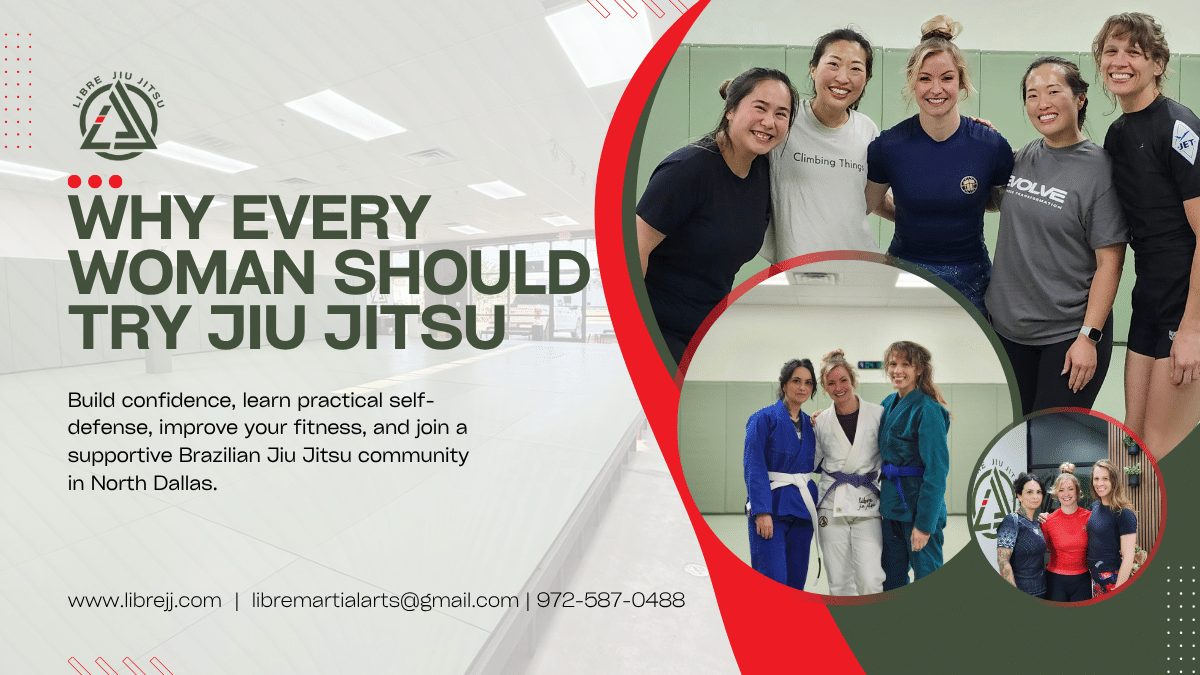
Ask women who train what keeps them coming back, and most will eventually talk about the people. There is something about trusting a partner with your safety, sweating through a hard round together, and helping each other improve that forms bonds quickly and deeply.
For women specifically, that connection tends to be even stronger. Training partners become a genuine support network: people who encourage you on a bad day, celebrate the first time you tap someone bigger, and understand exactly what you are working through, because they have been there. Many women find role models and mentors in higher-ranked women at the gym, which makes the whole journey feel possible. A lot of these friendships end up lasting way beyond the mat and become some of the most reliable relationships in a person’s life.
A welcoming academy is inclusive by design. People of all ages, sizes, and backgrounds train side by side, beginners are looked after, and the room is built so that a first-timer feels supported rather than tested.
Honest Answers to the Fears That Keep Women Away
Let us address the real hesitations directly, because they are valid.
“I will be the only woman there.”
Women’s participation in Jiu Jitsu has grown enormously, and you are far less likely to be alone than you would have been a decade ago. Beyond that, training with partners of different sizes (including men) is part of what makes the skill real: it teaches you to apply technique against exactly the kind of size disadvantage you would face if you ever needed it. A good gym pairs newcomers thoughtfully and controls the pace, so it never feels like being thrown in.
“I am not in shape for this.”
You get in Jiu Jitsu shape by doing Jiu Jitsu. There is no fitness prerequisite. Beginners of every level start every week, rest when they need to, and improve faster than they expect. The mat is the gym.
“I am worried about getting hurt.”
The combination of no striking, slow and cooperative drilling, and the tap makes a well-run room one of the safer physical activities you can do. You control the off switch at all times: the moment you feel uncomfortable, you tap, and your partner stops instantly. Minor soreness is the usual extent of it for a beginner.
“I am uncomfortable with the close physical contact.”
This is a completely understandable concern, and a good academy takes it seriously. The contact is structured, purposeful, and respectful, and the entire culture is built on consent and boundaries (stop means stop). Many women who were anxious about this at first describe how quickly it stops feeling personal and starts feeling like solving a physical puzzle with a teammate. If anything ever feels wrong, you have both the right and the explicit permission to stop.
“I will embarrass myself.”
Everyone was a nervous beginner once, and the people on the mat remember it well. The culture rewards showing up and trying, not being good immediately. Confusion in your first few classes is normal and expected, not a sign you do not belong.
What Your First Class Will Actually Look Like
So you know what to expect, here is the simple version. You will arrive a little early, meet a coach, and let them know it is your first time. A class typically opens with a warm-up (movement drills, nothing you need to be good at), moves into the coach demonstrating a technique, then has you drill that technique slowly with a partner who helps you through it. Some classes include light, controlled positional practice, and as a first-timer you can always sit that out and watch. The whole thing usually runs about an hour and ends with a handshake and a thank-you to your partners.
Wear a fitted athletic shirt or rash guard and athletic shorts or leggings without pockets or zippers, with a sports bra underneath, and tie back long hair. Bring water and clip your nails short. That is genuinely all you need for day one, whether the class is in the gi or no-gi grappling.
You Do Not Have to Be Aggressive to Be Good
A common assumption is that you have to be naturally aggressive or competitive to do well at a combat sport. Jiu Jitsu quietly dismantles that idea. Because it rewards patience, problem-solving, and precise technique over raw aggression, some of the most effective practitioners are calm, methodical, and thoughtful. You do not win by being the angriest person in the room. You win by being the one who stays composed and applies the right technique at the right moment.
For many women, that is a revelation. You do not have to become someone you are not. You bring your own temperament to the mat, and the art rewards a clear head far more than a fierce one. The composure you build is the real weapon, and it is a trait that serves you everywhere, not just in training.
What Progress Looks Like: The Belt Journey
It helps to know what the road ahead looks like, so the early weeks feel less like wandering. Adults in Brazilian Jiu Jitsu progress through belt ranks (white, blue, purple, brown, and black), and along the way you earn stripes that mark smaller milestones. Progress is intentionally gradual, because the art is deep, and that is part of what keeps it rewarding for years rather than weeks.
In your first month, the goal is simply to get comfortable: learning to move, to breathe, to relax under pressure, and to remember a few basic positions. By a few months in, techniques start to connect, and you begin to recognize situations rather than feeling lost. The belt system is not a race. It is a long, satisfying arc of steady improvement, and the women who fall in love with the journey are usually the ones who stop measuring themselves against anyone else and start measuring against who they were last month.
Training With Bigger and Stronger Partners
This sounds intimidating, and it is one of the most common worries, so it is worth addressing head on. Training with larger, stronger partners (including men) is not a hazard to endure. It is one of the most valuable parts of the experience for a woman, for a simple reason: if you ever need your skills to defend yourself, the person will almost certainly be bigger and stronger than you. Practicing against exactly that size difference, in a safe and controlled room, is how you learn that technique genuinely overcomes a strength advantage.
A good academy manages this carefully. Beginners are paired thoughtfully, experienced partners are expected to control their intensity and protect newer students, and you always have the tap to stop anything instantly. Over time, holding your own with someone twice your size stops feeling frightening and starts feeling like proof of how far you have come. That proof is hard to get anywhere else, and it changes how you carry yourself off the mat.
Start at Libre Jiu Jitsu in Farmers Branch
We built our program so that a woman who has never done a martial art can walk in and feel welcome, supported, and safe from the first minute. Our coaches are used to teaching complete beginners, our culture leaves ego at the door, and our mat is the kind of place where you are looked after as you learn.
For women across Dallas, North Dallas, Farmers Branch, Carrollton, and Addison, a few practical things:
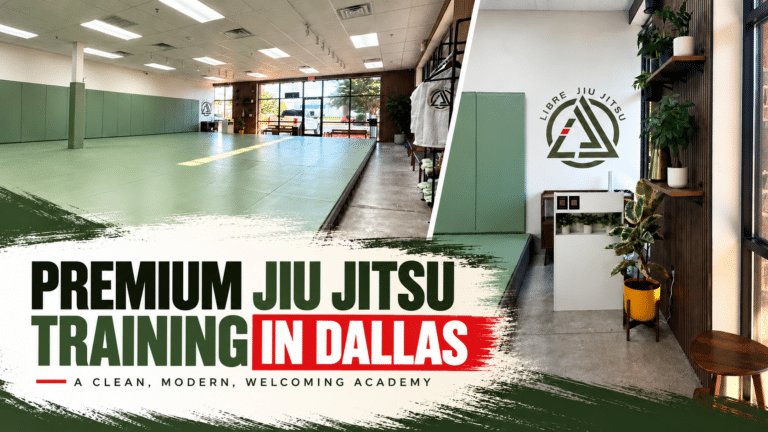
- We are easy to reach and easy to park at, located right off I-35E and Valley View Lane.
- Our classes welcome beginners, and our coaches control the pace so you never feel thrown in.
- The culture is supportive, respectful, and built on clear boundaries.
- You can check our weekly class times.
The best way to find out whether this is for you is to try it with no cost and no pressure. We offer a free trial week for new students (a real free trial BJJ Dallas women can book with no commitment), so you can experience a real class before deciding anything. Our adult BJJ classes welcome women of every level. When you are ready to keep going, our flexible BJJ memberships include monthly, three-month, six-month, and yearly plans.
You’ve got the full picture now: the mechanics that make it work for a smaller body, the real self-defense value, the fitness and confidence, and the community waiting for you. The only thing left is to step on the mat. Book your free week of classes at Libre Jiu Jitsu and see what you are capable of.
Frequently Asked Questions
Do I need to be strong or athletic to start jiu jitsu?
No. Jiu Jitsu is designed so that technique and leverage beat size and strength. You build the relevant fitness by training, and beginners of every level start every week.
Is jiu jitsu good for women’s self-defense?
Yes. It teaches you to defend yourself from realistic positions (including from your back), to stay calm under physical pressure, and to set and hold boundaries, all practiced against resisting partners so the skills actually hold up.
Will I be the only woman in the class?
Probably not, since women’s participation has grown a lot. Training with partners of different sizes is also part of what makes the skill effective and real.
Is the close contact a problem?
The contact is structured, respectful, and built on consent. The tap means you can stop anything instantly. Most women find it quickly stops feeling personal and starts feeling like teamwork.
What should I wear to my first women’s jiu jitsu class?
A fitted athletic shirt or rash guard, athletic shorts or leggings without pockets or zippers, and a sports bra underneath. Tie back long hair, clip nails short, and bring water.
How do I try a class in North Dallas?
Libre Jiu Jitsu in Farmers Branch offers a free trial week. Reach out through Libre Jiu Jitsu to set it up, then arrive about fifteen minutes early on your chosen day.