Walking into a Brazilian Jiu Jitsu academy for the first time can feel like a lot. You are about to try something physical and unfamiliar, usually in a room full of people who already know the routine. That nervous feeling is completely normal, and it is one of the most common reasons people put off starting for months or even years.
Here is the reassuring part: almost none of the things first-timers worry about actually happen. Nobody throws you to the wolves. Nobody expects you to know anything. And you will not be the only beginner in the room. This guide walks you through exactly what to expect at your first jiu jitsu class, from the morning you wake up to the moment you step off the mat, so you can show up calm, prepared, and ready to enjoy it.
At Libre Jiu Jitsu, located right off I-35E and Valley View Lane in Farmers Branch, we welcome brand new adults onto the mats every single week. Many of them had never tried a martial art in their life. By the end of this article you will understand the full flow of a class, the unspoken rules, how the safety system works, and what to do before you ever leave the house. No guesswork.
Why the First Class Feels Scarier Than It Is
Most of the fear around a first BJJ class comes from not knowing the rules. You are stepping into a space with its own culture, its own etiquette, and its own vocabulary, and your brain fills the blanks with worst-case scenarios.
The three fears we hear most often from new adults across North Dallas and Carrollton:
- “I am too out of shape to start.” Jiu Jitsu is one of the rare activities where you build the exact fitness it requires by doing the activity itself. You do not need to get in shape first. The mat is where you get in shape. Coaches expect beginners to be winded. It passes faster than you would believe.
- “Everyone will be better than me and I will embarrass myself.” Every person in that room was once a nervous beginner. They remember day one clearly, and the culture rewards showing up, not showing off.
- “I will get hurt.” Jiu Jitsu has a built-in safety release valve (the tap) and a no-striking format. We explain both in full below. On day one it is far gentler than most people picture.
Once you actually see it in person, the mystery disappears and most of that anxiety just goes away.
Before You Even Leave the House
A smooth first class starts long before you arrive. Handle these basics and you remove half the stress.
What to Wear
You do not need to own a gi (the traditional uniform) for your first session. Most academies, ours included, will lend you a gi or let you train in athletic clothes for an introductory class.
For a gi class, you will eventually want:
- A clean, dry gi (also called a kimono)
- A belt (most gyms lend one until you have your own)
- A rash guard worn under the gi top
For a no-gi class, you will want:
- A fitted rash guard
- Grappling shorts or spats (tight athletic leggings)
If you are training in your own clothes for an intro session, bring a fitted athletic shirt and athletic shorts without zippers, buttons, or pockets. Loose clothing and metal hardware are the small hazards that catch fingers and toes during grappling. Avoid baggy t-shirts and anything with a drawstring tipped in metal.
A note for women: a sports bra under the rash guard, plus fitness shorts or leggings under the gi pants, keeps everything secure and comfortable through the full range of movement. Remove makeup before training, since the contact is close and constant.
Pack a Simple Gym Bag
- Water bottle (put your name on it, you will sweat more than you expect)
- A small towel
- A dry change of clothes for after
- Sandals or flip-flops for any time you step off the mat
Keep your gear clean and fully dry between sessions. Damp equipment holds bacteria and breaks down faster.
Hygiene Is a Rule, Not a Courtesy
This is the single most important point of etiquette in grappling, and it is worth stating plainly. Jiu Jitsu is close-contact, so hygiene is a shared safety issue.
Before class:
- Shower or arrive clean, and use deodorant
- Clip your fingernails and toenails short (long nails cause most of the minor scratches that happen on the mat)
- Tie back long hair
- Cover any open cut with a waterproof bandage
- Stay home if you have a skin infection (like ringworm) or are feeling sick, because these spread easily in a grappling room
Skip cologne, perfume, and heavy lotion. You will be inches from someone’s face.
What to Eat and Drink
Do not arrive on a full stomach. Grappling puts pressure on your midsection, and a heavy meal an hour beforehand is a recipe for feeling sick. Eat a light, easily digestible meal two to three hours before, and hydrate steadily through the day rather than chugging water right before you walk in.
Arrive Ten to Fifteen Minutes Early
Getting there early gives you time to park (our spot off Valley View Lane is easy to reach, with parking on site), sign the waiver, meet the coach, change, and watch a minute of the previous class so the room feels familiar. Arriving early on day one is the difference between a calm start and a rushed, flustered one.
Walking Through the Door: The First Ten Minutes
When you arrive, find the front desk or the coach and say it plainly: “Hi, it is my first class.” That single sentence flips a switch. A good academy will introduce you to the instructor, assign someone to look after you, and slow the pace down for you. (If nobody acknowledges that you are new or introduces you to a coach, treat that as a small warning sign about how the place is run.)
A few etiquette points take effect the moment you step inside:
- Shoes off the mat, always. You will see shoes lined up at the mat’s edge. The training surface stays clean because nobody walks on it in street shoes. This is one reason grappling academies are cleaner than outsiders assume.
- Footwear on whenever you are off the mat. Wear sandals to the bathroom and locker room, then put your bare feet back on the clean mat. It’s a simple habit that keeps the mats clean.
- No jewelry on the mat. Rings, chains, and earrings catch and tear.
- Sign the waiver before you train. Standard at every legitimate gym.
Then you change into your gi or training clothes and wait at the edge of the mat. When the coach calls everyone on, you step on (bare feet) and line up, usually in order of belt rank.
What Happens at a Jiu Jitsu Class: The Full Structure
This is the part that calms most nerves. A class is not chaos. It follows a predictable order, and once you know the order, you always know roughly what is coming next. Here is what happens at a jiu jitsu class from start to finish, with the typical timing for each phase.
Opening and Warm-Up (10 to 15 minutes)
The class starts with light jogging, mobility work, and jiu jitsu movements like shrimping, bridging, and technical stand-ups. As a beginner, just move at your own pace — awkward is completely normal and warming up safely matters more than precision.
Technique Instruction (20 to 30 minutes)
The coach demonstrates one to three related techniques and students drill them together. Watch closely, ask questions, and focus on just one detail at a time.
Drilling and Positional Training (15 to 20 minutes)
This phase is all about repeating the technique with light resistance, often starting from a set position. Prioritize control and correct movement over speed or strength.
Live Sparring (Varies — often optional for new people)
This is free practice under the coach’s supervision. Go slow, breathe, and tap early. If it feels like too much, you can absolutely sit this one out on day one.
Cool-Down and Close (About 5 minutes)
The class wraps up with light stretching, a few notes from the coach, and a line-up. Listen, observe, and thank your training partners before you leave.
Stage 1: The Warm-Up
Class usually opens with a short line-up and a word from the coach, then the warm-up. It raises your heart rate and teaches the basic movement patterns you will use forever: shrimping (a hip-escape motion), forward and backward rolls (controlled and low to the ground), bridging (lifting your hips off the floor), and similar drills.
You are not expected to do these perfectly. On day one, copy the person next to you and move at your own pace. Pace yourself here, because new people often go too hard in the warm-up and have nothing left for the actual learning. Fun fact most first-timers do not expect: it is your forearms that tend to feel strangely sore the next day, from all the gripping.
Stage 2: Technique of the Day
This is the heart of the class. The coach demonstrates a specific technique, broken into steps, and explains the small details that make it work. It might be a position (like holding someone in side control), an escape (like getting out from underneath), or a submission and its defense.
A core concept you will hear early is position before submission: you learn to stabilize and control safely first, long before you worry about finishing anything. For a true beginner, the coach or an assigned upper belt will often teach you a simpler version off to the side. This is normal and expected. You are not being singled out for being slow. You are being taught at the right level.
Stage 3: Drilling With a Partner
After the demonstration, you pair up and practice on each other. One person performs the move slowly while the other gives light, cooperative resistance, then you switch. This is cooperative practice, not a fight. Your partner is helping you, and you are helping them.
This is where the “what do I do with my hands” panic fades, because you have a clear task: copy the move you just watched, rep after rep. Your partner will often coach you through it. Lean on that, and ask questions freely. Asking questions is welcomed, not annoying.
Stage 4: Positional Sparring or Light Rolling
Some beginner-friendly classes add a round of positional sparring, where you start from a set position (say, one person holding the other down) and work toward a single goal, like escaping. It is focused and far less overwhelming than free sparring.
Many academies do not put first-timers into full live sparring (called “rolling”) at all, or they pair you only with an experienced upper belt who controls the pace entirely. If you are invited to roll, you can absolutely decline on your first class. Just say, “I would like to sit this one out and watch.” That is a completely accepted choice. When you do start rolling later, it is light, technical, and governed by the tap. There is no striking of any kind in Brazilian Jiu Jitsu.
Stage 5: The Close
Class ends with a line-up, sometimes a bow or handshake, and a few words from the coach. People shake hands or fist-bump their partners and say thanks. Then you step off the mat, put your sandals back on, and you are done. A typical class runs about an hour, give or take.
The Different Kinds of Classes You Might See
Not every class on the schedule is the same, and knowing the difference helps you pick the right one to start with.
- Beginner or fundamentals classes group new students together so the coach can teach the basics without overwhelming anyone. This is the ideal entry point.
- Mixed-level classes put beginners and experienced students together. These are very common, and beginners are usually paired with a higher belt who guides them. Do not be intimidated by training with a higher belt. It is actually the safest, most helpful pairing you can get.
- No-gi classes follow the same format but use a rash guard and shorts instead of the gi. The pace is faster and slipperier, so expect a few more bumps when you are new to it.
- Competition classes are fast, demanding, and built for athletes preparing to compete. These are not a good starting point for a brand new student.
When you book your first session, start with a fundamentals or beginner-friendly class. You can always branch out later.
The Tap: How the Safety System Actually Works
If you take one idea away from this article, make it this one. The tap is the foundation of safe training in Jiu Jitsu, and understanding it removes most of the fear of injury.
When you are caught in a submission (a hold that controls a joint or restricts air flow), you do not wait until something hurts. The moment you feel uncomfortable, trapped, or simply unsure, you tap your partner’s body or the mat firmly two or three times, or you say “tap” out loud. Your partner releases instantly.
That is the whole system. Tapping is not losing. It is communicating. Every person in that room, including the highest-ranked black belt, taps regularly. It is how everyone trains hard for years without getting hurt.
The rules around the tap:
- You can tap any time, for any reason. Discomfort, fatigue, a tweak, claustrophobia, or just wanting to reset. No reason required.
- The person applying the hold must release immediately. This is non-negotiable, and a good coach enforces it without exception.
- Tap early. New people sometimes wait too long out of pride. Do not. Tap early and often while you learn your body’s signals.
No striking, slow controlled drilling, and the tap together are why a properly run Jiu Jitsu room is one of the safer contact activities an adult can do.
Mat Etiquette: The Unwritten Rules, Written Down
Etiquette is just shared courtesy that keeps everyone safe and the room running smoothly. Here is what you will be expected to follow.
- No shoes on the mat, footwear on whenever you step off it.
- Keep your nails short and your gi or rash guard clean.
- Tell your partner about any injury before you start, like a bad knee or a sore wrist, and they will train around it.
- Tap when you need to, and respect the tap instantly when others do.
- When the coach is teaching, stay seated and pay attention. Do not lie down on the mat and do not coach over the instructor.
- Ask permission before leaving the mat during instruction.
- No phones, no food or gum on the mat, and keep the ego in check.
- Bow or acknowledge the mat as the academy’s custom dictates, and thank your training partners at the end.
None of this is hard. Most of it is common sense plus cleanliness, and within a class or two it becomes automatic.
What You Will Actually Feel
Honest expectations help you stick with it past day one.
You will feel confused. That is the correct response to your first class. You are learning a physical language from scratch. Feeling lost is totally normal, everyone starts there. Give it three to five classes before you decide if it’s clicking, and it will.
You will get tired faster than expected. Grappling uses muscles and breathing patterns you do not use in daily life. This improves quickly with consistent attendance.
You might feel a little claustrophobic. Having someone control your body is a new sensation. Breathe slowly and remember the tap is always there. Learning to stay calm under pressure is one of the most valuable skills Jiu Jitsu teaches, and the feeling fades fast.
You will likely be sore the next day and may get a minor bruise. This is normal and mild, the same low-level soreness you would get from any new physical activity.
You will probably feel a strange satisfaction. Most people leave their first class tired but smiling, because they tried something difficult and got through it, surrounded by people who were kind about it.
Common Beginner Mistakes to Avoid
- Going too hard: New people use maximum strength and speed, which tires them out and slows learning. Relax, move slow, let technique do the work.
- Holding your breath: Under pressure, beginners hold their breath and gas out. Breathe deliberately, even when it feels odd.
- Being too proud to tap: Tap early. There is no medal for refusing.
- Skipping questions: If you do not understand a move, ask. Coaches would rather you ask than struggle silently.
- Comparing yourself to the colored belts: They have years on you. The only fair comparison is you today versus you last week.
- Quitting after one class: Day one is the hardest day because everything is brand new. It gets noticeably more fun by class three or four.
After Your First Class: What Comes Next
When class ends, hydrate, change into your dry shirt, and wash your gi or training clothes the same day. Gear should never sit damp in a bag.
Then reflect honestly. Did the coach make you feel welcome? Was the room clean? Did training partners control their intensity and respect the tap? Those are the marks of a healthy academy, and If you leave feeling good about it, you’ve probably found your gym.
If you enjoyed it, the best thing you can do is come back within a few days, while the movements are fresh and the nerves of the unknown are already behind you. Consistency in the first month is what turns a curious first-timer into someone who genuinely loves training.
Your First Class at Libre Jiu Jitsu in Farmers Branch
We built Libre Jiu Jitsu to be the kind of room a nervous beginner can walk into without dread. Our coaching staff is used to working with adults trying jiu jitsu for the first time, and the culture on our mats is friendly and ego-free. New people get looked after, not tested.
A few practical things that make a first visit easy for folks across Farmers Branch, North Dallas, Carrollton, and Addison:
- Easy to find and easy to park, located right off I-35E and Valley View Lane, a short drive from anywhere in the North Dallas area.
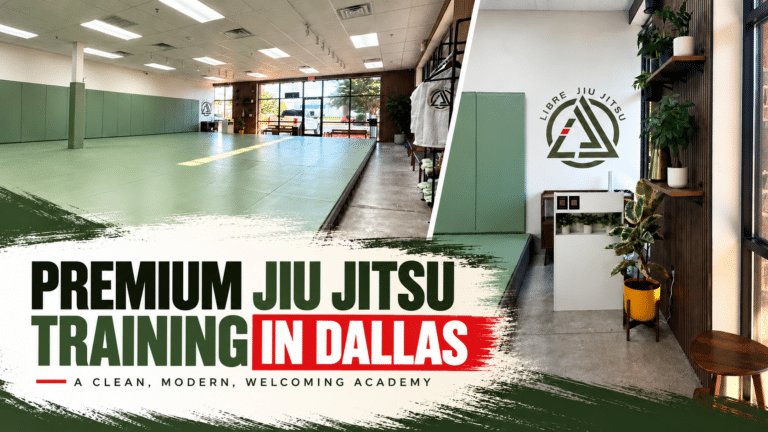
- A clean, well-kept training space, because hygiene is part of how we run the room, not an afterthought.
- Coaches who slow things down for beginners and pair you with people who control the pace.
- A schedule that fits real life, with adult classes through the week. You can see exact times on our class schedule page.
The simplest way to find out whether Jiu Jitsu is for you is to try it with zero pressure and zero cost. We offer a free trial week, so you can experience a real class (or several) before deciding anything. You can read about our programs on the Libre Jiu Jitsu home page, and when you are ready to continue, our flexible membership options include monthly, three-month, six-month, and yearly plans.
You have read the full playbook now. You know what to wear, what to bring, how a class flows, how the tap keeps you safe, and what the etiquette is. The hardest part is honestly just showing up that first time. Book your free week of classes at Libre Jiu Jitsu and find out how good it feels to start.
Frequently Asked Questions
Do I need to be fit before my first jiu jitsu class?
No. You build jiu jitsu fitness by training jiu jitsu. Beginners of every fitness level start every week. You move at your own pace and rest whenever you need to.
What should I wear if I do not own a gi?
A fitted athletic shirt or rash guard and athletic shorts without pockets, zippers, or buttons. Most academies, ours included, can lend you a gi for an intro class.
Will I have to fight someone on my first day?
No. Your first class focuses on warm-ups, learning a technique, and cooperative drilling. If live sparring happens, beginners can decline it entirely or be paired only with an experienced partner who controls the pace.
Is jiu jitsu safe for a complete beginner?
Yes. There’s no striking, drilling is slow and cooperative, and you can tap out of anything at any time. Minor soreness or a small bruise is the typical extent of it for new people.
How long is a jiu jitsu class?
Most classes run about an hour, including warm-up, technique, drilling, and a short close.
How do I try a class in Farmers Branch?
Libre Jiu Jitsu offers a free trial week. Reach out through our home page to claim it, then show up about fifteen minutes early on the day you choose.