Your child’s first Jiu Jitsu class is mostly nerve-wracking for you, not them.
Kids are remarkably adaptable. Throw them into a new room with a coach and some structure, and most of them find their footing inside the first 15 minutes. Parents, on the other hand, sit on the sidelines running through every possible scenario: Will she be overwhelmed? Will he get hurt? Is this too intense? Are they going to like it? Should I step in if they look uncomfortable?
Here is the reality: a well-run kids Jiu Jitsu class is one of the safest, most structured physical activities your child can participate in. It is not a cage fight. It is not a free-for-all. It is a carefully organized session that blends movement, technique, play, and discipline into an hour that leaves most kids both tired and asking when they can come back.
But understanding what actually happens during that hour, what the class structure looks like, what the coach is doing and why, and what “normal” looks like for kids at different stages, goes a long way toward making the experience feel smooth for the entire family.
If you’re looking for kids Jiu Jitsu in Farmers Branch or the Dallas area, Libre Jiu Jitsu offers a free trial week so your child can experience the class without any commitment. You will see exactly what this post describes, and you will watch your child’s face while they experience it firsthand.
The Structure of a Typical Kids BJJ Class
Kids BJJ classes follow a consistent structure for a reason. Children thrive on predictability.
Here is the general framework of a kids Jiu Jitsu class at a well-run academy. The specifics vary by age group and instructor, but the bones are the same.
Arrival and Line-Up (5 Minutes)
When kids arrive, they learn to place their shoes in a designated spot, step onto the mat, and line up in a specific order. This is not arbitrary. It teaches them the routine and signals that mat time is different from regular time. The structure begins before the first drill.
A coach or staff member greets each child and directs them to the right spot. For new students, this initial greeting matters enormously. A warm, calm introduction to the space and the coach sets the tone for everything that follows.
Parents typically watch from a designated viewing area. Your presence is welcome and encouraged, especially for the first few classes. Seeing a familiar face across the room helps kids feel anchored in an unfamiliar setting.
Warm-Up (10 Minutes)
Every class starts with a warm-up. These are not intense conditioning drills. They are movement activities designed to wake the body up, build coordination, and introduce fundamental movement patterns that appear later in the techniques.
Common warm-up activities for kids include:
- Running and skipping: Light cardio to get the blood moving and shake off the energy or nervousness they walked in with.
- Crawling drills: Bear crawls, crab walks, and other animal movements that develop core strength, coordination, and spatial awareness. Kids enjoy these because they feel like play.
- Rolling: Forward rolls, backward rolls, and side rolls that build body awareness and prepare kids for the falling and tumbling inherent in grappling.
- Hip escapes (shrimping): This sideways movement along the mat is one of the most important motions in all of BJJ. It looks strange at first. It becomes second nature fast.
- Bridging: Lying on the back and driving the hips upward. This movement is the foundation of every escape from bottom position.
The purpose of the warm-up is comfort, not exhaustion. Kids learn to follow simple instructions, move with the group, and adjust to the physical space. Even the shyest students usually start smiling during this phase because the movements feel more like a game than an exercise.
Technique Instruction (15 to 20 Minutes)
After the warm-up, the coach introduces the technique of the day. This is the instructional core of the class.
The coach demonstrates a specific Jiu Jitsu movement or position, usually broken into small, clear steps. For kids, this might include:
- Safe falling (breakfalls): How to absorb the impact of being taken down without getting hurt. This is one of the most practical skills your child will ever learn, on the mat and off it.
- Basic positions: Guard, mount, and side control are the three foundational positions in BJJ. Kids learn to recognize them, enter them, and understand why one position is better than another.
- Simple escapes: Getting out from under a partner who has established a controlling position. This is where kids learn that strength is not the answer, and that technique and timing work even when you are smaller.
- Basic control techniques: How to hold a position, maintain pressure, and stay stable while a partner tries to move. This teaches patience, body awareness, and physical control without aggression.
- Introductory submissions: For older or more experienced kids, coaches may introduce simple joint locks or chokes with extensive emphasis on safety, control, and the concept of tapping out.
Coaches break each technique into small pieces. They demonstrate, explain, and demonstrate again. For younger kids, the explanations are shorter and the demonstrations are more visual. For older kids, the instruction may include more detail about why a technique works and how it connects to other positions.
The key thing parents should watch for during this segment is the coach’s patience and communication style. A good kids BJJ instructor does not rush through techniques. They do not raise their voice when a child is confused. They repeat, they adjust, they encourage. The pace is set by the students, not the curriculum.
Partner Drills (15 to 20 Minutes)
Once the coach has demonstrated the technique, kids pair up and practice it with a partner.
This is where many parents hold their breath. Relax.
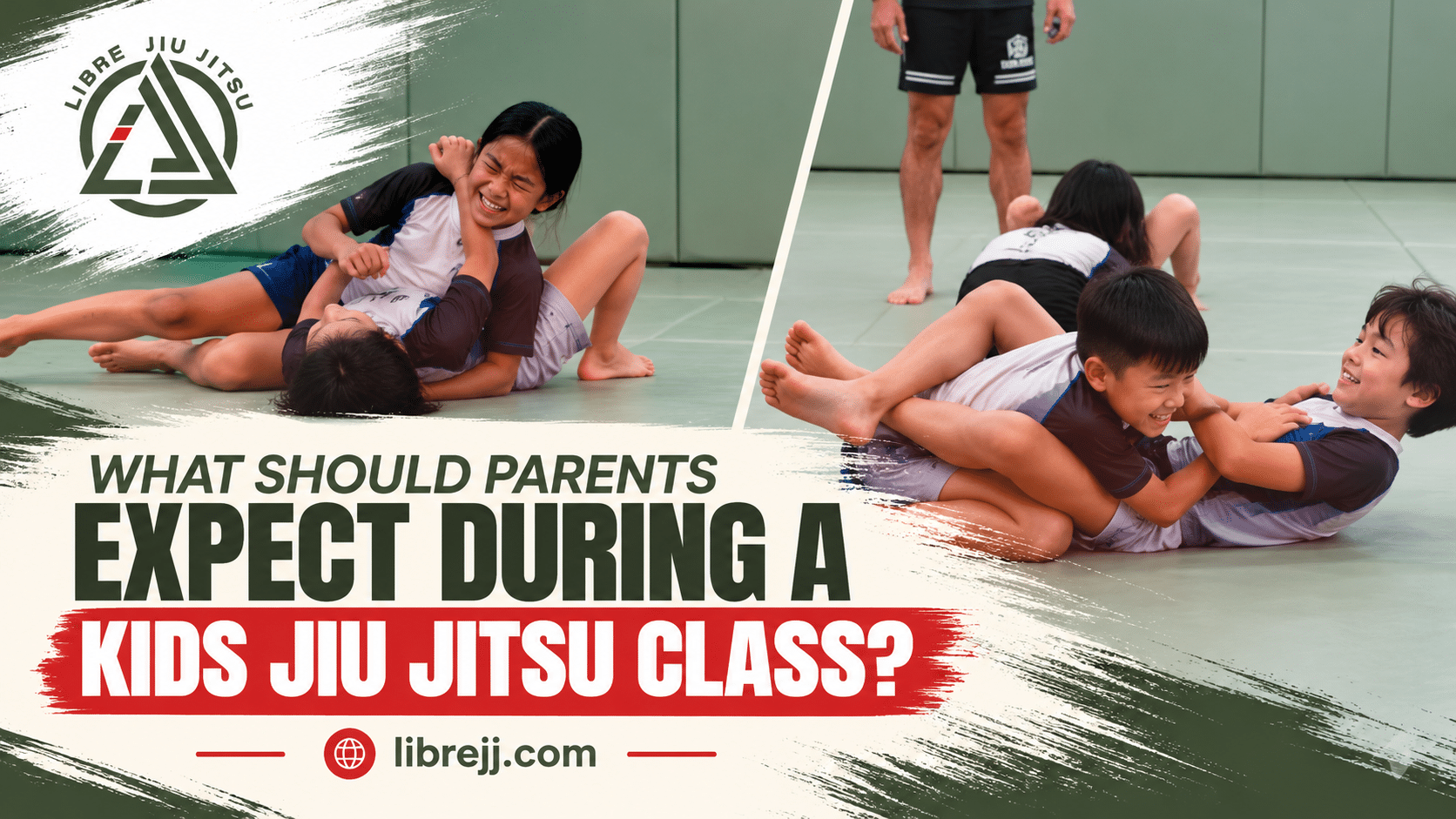
Partner drills in kids BJJ are cooperative, not competitive. The goal is for both partners to practice the movement correctly, not for one to “beat” the other. Coaches pair kids by size and comfort level, and they stay close to monitor every pair.
Kids learn important social skills during this phase:
- Taking turns: One partner executes the technique while the other provides the right kind of resistance, then they switch. This teaches patience, cooperation, and the concept of mutual benefit in training.
- Communication: Kids learn to say “ready” before starting and “stop” or “tap” when they need a pause. These simple verbal cues give children a sense of control and agency that many other physical activities do not provide.
- Appropriate physical contact: For many kids, BJJ is their first experience with structured, respectful close contact. They learn that physical contact can be respectful, controlled, and purposeful, a lesson that carries well beyond the mat.
Coaches circulate during partner drills, offering corrections, encouragement, and adjustments. They watch for pairings that are not working (size mismatch, energy mismatch, personality friction) and reorganize as needed.
Games and Movement Activities (10 Minutes)
This is the part of class that kids love the most.
Good kids BJJ programs weave games into the curriculum that reinforce the movements and concepts taught during the technique portion. These are not random playground games. They are structured activities designed to develop balance, reaction time, spatial awareness, and grappling-specific skills in a playful context.
Common BJJ games for kids include:
- Balance games: Two kids face each other on their knees and try to push each other off balance using only specific grips or contacts. This teaches base, weight distribution, and the feeling of being in a physical exchange without the intensity of sparring.
- Tag variations: Modified tag games where kids must move in specific grappling patterns (shrimping to escape, bridging to tag) reinforce technique through play.
- Reaction drills: The coach calls a position and kids must get into it as quickly as possible. This builds positional recognition and response speed in a competitive but low-stakes format.
- Escape games: One partner holds a controlled position and the other has a set time to escape using the techniques taught that day. This introduces live resistance in a contained, safe framework.
Parents watching from the sidelines will see laughing, friendly competition, and kids who have completely forgotten they were nervous an hour ago. This is by design. Play is the most effective learning tool for children, and coaches who understand this build games into every class.
Cool-Down and Closing Ritual (5 Minutes)
Classes end with a structured cool-down. Kids line up, take a few deep breaths, listen to a brief closing statement from the coach, bow, and shake hands with their classmates and instructor.
This closing ritual is not performance. It is practice. Kids are learning respect for their training partners, gratitude for the instruction, and the discipline of finishing something they started. The handshake with every person they trained with reinforces the social bonds that make an academy feel like a second home.
Many kids sprint straight to their parents after this final step, bursting with excitement to describe what they learned. That energy is a reliable sign that the class was well-structured and well-coached.
What Your Child Will NOT Do in Their First Class
Understanding what is not happening is just as important as understanding what is.
They will not spar live in their first session: Live rolling (free grappling with a resisting partner) is introduced gradually, not dropped on a brand-new student during their first visit. Most kids do not begin live rolling until they have attended consistently for several weeks and have a baseline understanding of positions, safety, and the concept of tapping.
They will not be pressured to perform: A first class is about comfort, not achievement. No coach worth their credentials expects a new student to execute a technique perfectly on their first try. The bar is showing up, participating, and finishing.
They will not be in a class with adults: Kids BJJ programs are age-separated for a reason. Your child will train with peers who are similar in age and size, supervised by coaches who specialize in teaching children.
They will not be unsupervised: At every stage of the class, from warm-up to cool-down, a coach is actively monitoring the room. During partner drills and any live activities, coaching staff are positioned to intervene immediately if anything goes sideways, which in a well-run program, it rarely does.
Want to see it for yourself? Your child’s free trial week at Libre Jiu Jitsu lets you watch every class from the parent viewing area before you sign up. Book your free week here
What Parents Should Look For (Beyond the Techniques)
When you are watching your child’s first BJJ class, it is tempting to focus on whether they are “getting” the techniques. Resist that urge. Your child will not remember the finer points of a guard escape after one class, and that is completely fine.
Instead, watch the environment. The environment tells you far more about whether this is the right place for your child than any single technique demonstration.
Coach Behavior
- Are the instructors patient when a child is confused?
- Do they speak clearly and at a pace kids can follow?
- Do they physically demonstrate rather than just verbally explain?
- Do they address each child by name?
- Do they handle corrections with encouragement rather than criticism?
Class Organization
- Is there a clear structure that the kids understand and can anticipate?
- Are transitions between activities smooth or chaotic?
- Is the energy level appropriate for the age group?
- Are the warm-ups and drills scaled to the abilities of the youngest students in the room?
Student Behavior
- Are the other kids respectful of each other?
- Are they engaged, or are they wandering and distracted?
- Do they seem comfortable with the coach?
- Is there bullying, roughhousing, or exclusion happening?
Safety
- Is the mat clean and in good condition?
- Are there enough coaches for the number of students?
- Are pairings appropriate by size and experience?
- Do coaches intervene quickly when a drill goes off course?
These observations tell you whether the academy’s culture is safe, supportive, and well-managed. And that culture matters far more for your child’s long-term experience than any specific curriculum detail.
Common Concerns Parents Have (and Honest Answers)
“What if my child is too shy to participate?”
This is one of the most common concerns parents bring up, and it is one of the easiest to address.
Many kids are shy on day one. Some stand at the edge of the mat and watch for the first 10 minutes. Some participate quietly without making eye contact with anyone. Some need a parent’s encouragement to step onto the mat at all.
All of this is normal.
Good coaches recognize shy students and give them space. They do not force participation. They invite it. A shy child might be paired with a particularly friendly, experienced student. They might be given a small, achievable task (“just try the first part of the movement”) to build early momentum. They might simply be told, “It is okay to watch for a minute. Jump in whenever you are ready.”
Most shy kids are fully participating by the second or third class. The structure provides safety. The games provide engagement. The small wins provide confidence. Shyness is a starting point, not a permanent state.
“Will my child get hurt?”
Parents often ask, is BJJ safe for kids? There’s no striking or kicking, and takedowns are taught slowly, starting with how to fall safely. The most common “injuries” are minor: light bruises, mat burn, and the kind of soreness that comes from using muscles in new ways.
The primary safety mechanism in BJJ is the tap. Children learn early and often that tapping out means “stop, I am uncomfortable.” This signal is respected by every training partner and enforced by every coach. Kids who learn to tap early learn to communicate physical limits, a skill that protects them on the mat and in every other physical activity they participate in.
Real injuries in kids BJJ are uncommon because the training is progressive, controlled, and supervised. Children are not doing anything their bodies are not ready for.
“My child has no athletic background. Can they still do this?”
Absolutely. Jiu Jitsu was designed around leverage and technique, not raw athleticism. Children who have never played a sport, who are uncoordinated, who are overweight, or who struggle in conventional athletic settings often flourish in BJJ precisely because the art rewards patience, problem-solving, and persistence over speed, strength, or natural talent.
Some of the most technically proficient young practitioners start out as the kids who could not keep up in gym class. BJJ gives them a physical pursuit where their brain matters as much as their body, and that shift changes everything.
“Do they have to spar? What does that look like?”
Not on day one. Not on day 30. Live rolling is introduced gradually, and only when a student has enough foundational knowledge to participate safely.
When kids do begin rolling, it looks very different from adult sparring. The intensity is scaled. The supervision is close. Rounds are short. Coaches pair students carefully and stop rolls that get too intense or one-sided.
Rolling for kids is play with structure. It is not fighting. It is competitive problem-solving with physical stakes low enough that the experience is exciting, not frightening.
“What should my child wear?”
For the first class, athletic wear is fine. A fitted t-shirt and shorts without pockets, zippers, or buttons work well. Avoid anything with hard edges or metal that could scratch a training partner.
If your child continues training, they will need a gi (the traditional BJJ training uniform). Most academies provide guidance on purchasing a gi, and many offer them through the school. A good kids’ gi costs between $50 and $100 and lasts through growth spurts if you size up slightly.
No jewelry, watches, or hair accessories with hard parts. Long hair should be tied back securely. Fingernails and toenails should be clipped short before every class.
What Happens After the First Class
Kids react differently to their first BJJ experience. Some come off the mat buzzing with energy and asking to sign up immediately. Some are quiet and need time to process. Some say “it was hard” or “I didn’t know what I was doing.” Some do not say much at all.
All of these responses are normal. And none of them are reliable predictors of whether your child will love BJJ long-term.
The better approach is to give it time. Ask open-ended questions rather than leading ones.
- “What was your favorite part?”
- “Was anything tricky?”
- “Would you want to try it again?”
Avoid making a permanent decision based on one class. Many children need two to four sessions before they feel comfortable enough to fully engage. The first class is an introduction, not a verdict.
If your child enjoyed the physical movement but was nervous about the social dynamics, that will settle with familiarity. If they liked the games but found the technique instruction boring, that balance shifts as they develop enough skill for the techniques to feel relevant. If they were overwhelmed by the novelty of the experience, the predictable structure of BJJ classes is specifically designed to make the second visit feel less intense than the first.
Age Groups and What They Mean
At Libre Jiu Jitsu, our kids program covers ages 6 to 15. Younger kids spend more time on movement, games, and following instructions. Older kids get more detailed technique and start structured rolling once they’re ready. Teens who are ready for more can move up as their skill and maturity allow.
Why Class Structure Matters More Than Technique
Here is a perspective that might shift how you evaluate a kids BJJ program.
When parents look at kids Jiu Jitsu programs, they often focus on which techniques their child will learn. But the specific techniques your child learns in their first month are less important than the structure and culture of the class. Techniques can be taught anywhere. A well-structured, psychologically safe training environment that builds confidence, discipline, and physical competence over years is much harder to find.
The class structure teaches your child:
- How to listen: Following multi-step instructions from a coach builds attention and processing skills.
- How to try and fail: Getting a technique wrong, adjusting, and trying again is the core loop of BJJ. Kids who internalize this loop develop a growth mindset that serves them in every area of life.
- How to interact physically with respect: Partner work in BJJ teaches boundaries, communication (through the tap), and cooperation at a level that few other activities reach.
- How to finish what they start: Completing a class, even when it is hard or boring or they are tired, builds perseverance. The closing ritual reinforces this accomplishment.
- How to be part of a community: The academy culture of mutual respect, shared effort, and celebrating each other’s progress gives kids a social framework they can carry with them.
These are not side effects of BJJ. They are the central benefits. The self-defense capability, the physical fitness, and the technical skill all matter. But the character development that comes from consistent participation in a well-run program is what parents remember most when their child is 16 and they look back at the decision they made to walk through the door.
Kids Jiu Jitsu in Farmers Branch: Libre Jiu Jitsu
At Libre Jiu Jitsu, our kids martial arts program is built for children who have never set foot on a mat. Our head coach, Omar Agado, has nearly 20 years on the mat and taught private lessons to kids for years before opening Libre, and the curriculum is designed to develop discipline, confidence, and real self-defense skills at a pace that respects each child’s readiness.
We run kids classes for ages 6 to 15, Monday through Saturday, at our Farmers Branch location. See the kids class times on our schedule, right off I-35E and Valley View Lane. The viewing area is open to parents, and our coaches are available after every class to answer questions about your child’s progress, goals, and next steps.
If you want to learn more about what BJJ does for kids beyond the class structure, our guide on the benefits of Jiu Jitsu for kids covers the discipline, confidence, and social development that parents see over time. And if safety is your primary concern, our post on whether Jiu Jitsu is safe for kids addresses the injury data, the role of the tap, and how the training compares to other youth activities.
Frequently Asked Questions
What age can kids start Jiu Jitsu?
At Libre Jiu Jitsu, our kids program is for ages 6 to 15. Classes focus on fundamentals, discipline, and building confidence on the mat.
How often should kids train BJJ?
Two classes per week is the sweet spot for most kids. This frequency allows consistent skill development while leaving time for school, homework, other activities, and rest. Some highly engaged kids train three times per week, which is fine as long as they are enjoying it and not showing signs of burnout.
What if my child wants to quit after a few classes?
Give it time. Many kids experience an adjustment period during their first two to four weeks. The novelty of the environment, the unfamiliar physical demands, and the social dynamics of working with new partners all take time to normalize. If your child is still resistant after four to six sessions, have an open conversation about what specifically is not working. Sometimes a schedule adjustment, a different class time, or a conversation with the coach is all it takes.
Will my child be grouped with much older or bigger kids?
Well-run programs group students by age and approximate size. At Libre Jiu Jitsu, coaches pay close attention to pairings during drills and rolling to ensure that children are working with partners who are appropriate for their size and experience level.
Can parents watch the class?
Yes. At Libre Jiu Jitsu, parents are welcome and encouraged to watch every class from the designated viewing area. Observing gives you insight into your child’s engagement, the coaching style, and the culture of the academy. After class, coaches are available for questions.
Does BJJ teach kids to be aggressive or fight?
No. BJJ teaches the opposite. It teaches kids to control their bodies, manage confrontation calmly, and resolve physical situations without aggression. Children who train BJJ consistently tend to become calmer, more confident, and less reactive, not more aggressive. The art rewards technique and composure over strength and force.
The First Class Is Just the Beginning
Your child does not need to be athletic, confident, or experienced to start Jiu Jitsu. They need a safe place to try.
The first class is designed to be welcoming, structured, and age-appropriate. The coaches are trained to work with new students. The other kids have all been where your child is right now. And the structure of the class is built to turn uncertainty into comfort within the first session.
The real growth happens over months and years. But it all starts with walking through the door.
Book your child’s free trial week at Libre Jiu Jitsu in Farmers Branch. We are located at 13150 Senlac Drive, Suite 190, Farmers Branch, TX 75234, right off I-35E and Valley View Lane. Call us at (972) 587-0488 or stop by during any of our kids class times to watch a session before signing up.
Your child might surprise you. Most of them do.