Most self-defense advice given to women is either useless or backwards. Carry pepper spray. Yell fire, not help. Park under a streetlight. Walk with your keys between your fingers. Take a two-hour seminar and you will be “empowered.”
Some of that advice is fine as far as it goes. But none of it addresses the actual problem: what do you do if someone bigger, stronger, and more aggressive gets a hold of you and will not let go?
That is the question Jiu Jitsu answers, and it answers it in a way no other martial art or self-defense system can match.
This guide is written for the woman thinking about self defense seriously. You may be searching for womens self defense classes Farmers Branch parents recommend, or looking into womens jiu jitsu Dallas options for the first time, or comparing BJJ in Dallas academies to see which one takes women’s training seriously. You will learn exactly how Jiu Jitsu keeps women safe, what real scenarios look like when you know how to respond, and what changes psychologically the longer you train. We will also cover our free trial BJJ Dallas offer at Libre Jiu Jitsu, which lets you try a full week of women’s classes and adult BJJ classes without any commitment so you can see how self-defense Dallas training actually feels from the inside.
The Reality Every Woman Already Knows
You do not need statistics to understand the situation. You have lived it your whole life. The mental math of walking to your car after dark. The second look at the man behind you in the parking garage. The instinct to send a friend your Uber license plate. The years of subtle, background-level awareness that most men never think about once.
That awareness is not paranoia. It is intelligence. But awareness alone does not equal safety. Awareness tells you a situation is wrong. Skill tells you what to do next.
Most self-defense systems marketed to women skip the skill part entirely. They sell awareness (already had it) or they sell adrenaline-based aggression tactics that fall apart the second someone actually grabs you. What women need is a system that assumes the worst has already happened, and gives you a real way out.
That is where Brazilian Jiu Jitsu comes in.
Why Traditional Self-Defense Falls Short for Women
Before we talk about what works, it helps to understand why so much of what gets taught does not.
The Strength Gap Problem
Most striking-based martial arts (karate, boxing, kickboxing) assume you can hit somebody hard enough to stop them. That is a fair assumption for a 200-pound man defending himself. It is not a fair assumption for a 130-pound woman being grabbed by a 220-pound attacker. Striking rewards mass and reach, and mass and reach are exactly what women usually do not have.
You can still throw a good punch. You should learn to. But if the situation gets past arms length, punching stops working. Almost every real assault on a woman ends up in close-quarters, hands-on, ground-adjacent range within a matter of seconds. Striking is designed for the range you want to escape from, not the range you actually end up in.
The Distance Illusion
Weapons-based self defense (knives, tasers, pepper spray, firearms) all share the same weakness: they require distance, time, and access. If somebody is already grabbing you, you cannot reach into your purse. If somebody has already tackled you, your keys are useless. Weapons are useful in the seconds before an assault. They are almost never useful once the assault is already happening.
Jiu Jitsu is designed for what happens after the pepper spray is out of reach.
The Panic Response
The single biggest reason self-defense fails in real situations is not lack of technique. It is the panic response. Adrenaline dumps into your bloodstream. Your fine motor skills evaporate. Your breathing gets shallow. You forget everything you were taught in that two-hour seminar six months ago.
The only known cure for the panic response is repeated exposure. You have to have been in the situation, or something like it, so many times that your body knows what to do without your brain having to think about it. Two-hour seminars cannot create that. Weekly, consistent training can, and does.
Why Jiu Jitsu Is the Great Equalizer
Brazilian Jiu Jitsu was designed, from the ground up, for exactly the scenario women fear most: a smaller person against a bigger, stronger attacker who has already closed the distance and gotten hands on them.
The founder of modern BJJ, Helio Gracie, was small, thin, and physically unimposing. He built the system specifically so that leverage, timing, and positioning could beat raw strength. Everything about Jiu Jitsu, from the way you use your hips to the way you frame with your arms, is built on the principle that technique defeats muscle.
That principle is why Jiu Jitsu is uniquely powerful for women.
Leverage Over Strength
In Jiu Jitsu, you never try to overpower somebody. You redirect them. You put your body in positions where their strength does not matter. You use joint angles, weight distribution, and small movements to create leverage that neutralizes size differences.
A 130-pound woman with two years of Jiu Jitsu can control a 200-pound untrained man on the ground. That is not marketing copy, that is a repeatable, demonstrable fact. It happens in academies every day.
Positional Understanding
Jiu Jitsu teaches you the map of every possible position two humans can be in when hands are on each other. Standing clinch. Mounted. Side control. Back control. Guard. Half guard. Each position has its own risks, its own defenses, and its own escapes.
Once you know the map, panic gets replaced by pattern recognition. You are not thinking “oh no, I am pinned.” You are thinking “this is side control, my next move is to shrimp toward my side and recover guard.” That kind of clarity under pressure is the difference between freezing and acting.
Composure Under Pressure
Every Jiu Jitsu class ends with live rolling, which is the term for practice sparring against a resisting partner. You spend hours per week under real pressure, breathing, thinking, and executing while somebody actively tries to control you.
You cannot fake this training. You cannot memorize your way through it. The only way to get good at handling pressure is to be under pressure over and over. After six months of rolling, the panic response no longer wins. You have been physically dominated hundreds of times in a safe environment, and you have found your way out every single time. That reprogramming carries into every situation for the rest of your life.
Real Scenarios: How Jiu Jitsu Actually Keeps You Safe
Here is where most self-defense articles fall apart. They stay abstract. They say things like “you will learn to defend yourself” without ever showing you what that actually looks like.
Let us get concrete. These are the situations women describe most often, and here is what Jiu Jitsu training actually does for each one.
Scenario One: The Parking Lot Grab from Behind
You are walking to your car. Someone approaches from behind and wraps their arms around you in a bear hug, trying to pull you toward a vehicle.
Without training: Your instinct is to pull forward, which is exactly what they want. You either get dragged, or you fall face-first while they still control your upper body.
With Jiu Jitsu training: You recognize the position instantly. Your first move is to drop your weight low (lowering your center of gravity), plant a wide base, and get one leg behind theirs. From there, you have multiple options: a hip throw that puts them on the ground behind you, a break-and-turn that faces you toward them, or a controlled fall that turns them into the crash instead of you. You are not “fighting.” You are executing a sequence you have drilled 300 times.
Scenario Two: The House Party Where Someone Will Not Let You Leave
You are at a friend’s place, or a bar, or a college function. Someone has been drinking and is not respecting a no. They grab your wrist to keep you from walking away.
Without training: You either escalate verbally (which sometimes works, sometimes triggers more aggression), or you comply out of fear of causing a scene.
With Jiu Jitsu training: Wrist grabs are one of the first things every student learns to escape. Your body knows the mechanics of breaking a grip using your thumb-side rotation. You break the grip cleanly, take a step back, and leave. The interaction takes two seconds. Nobody escalates because you never escalated in the first place. You just calmly, physically, removed yourself from a situation they thought they controlled. Confidence like that is a scenario-ender on its own.
Scenario Three: The Ride Share or Elevator That Turns Wrong
You are in a confined space with somebody, and something feels off. Then it goes past off. They lean toward you, put a hand where it does not belong, or reach for the door lock.
Without training: You freeze. You second-guess yourself. You wonder if you are overreacting. By the time you decide you are not, they have already taken the initiative.
With Jiu Jitsu training: You do not freeze because you have been in worse positions in class every week. Your body reacts faster than your doubt. In an elevator, you have already created angle and space using framing (a Jiu Jitsu concept of using your forearms as barriers). In a car, you know how to control the door lock arm and get out at the next stop. You are calm, quick, and completely certain of what to do because it is muscle memory now.
Scenario Four: The Ground Position (The Worst Case)
This is the scenario every self-defense course avoids talking about because it is scary. Somebody has forced you to the ground and gotten on top of you.
Without training: This is the moment most systems have no answer for. Once you are pinned, punching, kicking, and running are all off the table. This is where women historically feel most helpless.
With Jiu Jitsu training: This is what Jiu Jitsu was invented for. From your back, you are not helpless. You are in a position called guard, and guard is arguably the strongest defensive position in Jiu Jitsu. You have your legs, hips, and arms all still functional. You can control their posture, prevent their punches, sweep them to your top position, or execute a submission. Everything about the ground game was designed by and for smaller people who ended up here. You are not weak on the ground once you have trained. You are more equipped there than most attackers will ever be.
Scenario Five: The Confrontation That Escalates
Somebody is yelling at you in a store parking lot, or road rage escalated, or a stranger got aggressive during a dispute. They start closing distance.
Without training: You freeze, or you get loud, or you try to walk away and they follow.
With Jiu Jitsu training: You know how to control distance. You have learned to keep your hands up in a non-aggressive but ready posture. You know the exact range you need to maintain to have time to react. If they lunge, you have practiced clinch control (grabbing the head and one arm to neutralize incoming strikes), and you have practiced disengaging cleanly from clinch to escape. You do not need to hurt them. You just need to control the situation long enough to get to safety, and Jiu Jitsu gives you the tools to do exactly that.
The through-line across every one of these scenarios: Jiu Jitsu does not train you to fight. It trains you to control, escape, and leave. That is what self defense actually means.
The Psychological Transformation
Physical technique is only half of what women get from training. The other half, and arguably the more important half, is what happens inside your head over time.
Learning What Your Body Can Actually Do
Most women grow up receiving constant, subtle messages that their bodies are decorative, fragile, or in the way. Jiu Jitsu breaks that programming completely. You spend hours per week feeling exactly how strong, capable, and effective your body actually is when you use it correctly. You feel your hips move in ways you never knew they could. You feel your grip clamp down and hold. You feel yourself sweep a training partner twice your weight because you executed the technique clean.
That kind of embodied knowledge changes how you carry yourself in every room you walk into.
The Confidence That Shows in How You Walk
Predators pick targets. They pick them based on posture, awareness, and perceived confidence. This is not opinion, this is documented research from interviews with actual violent offenders.
Six months into consistent Jiu Jitsu training, your posture changes. You take up more space. Your shoulders sit differently. Your eyes make contact instead of avoiding it. You walk with a purpose that comes from knowing, at a physical level, that you are not easy to control.
You do not have to look intimidating. Confident is enough. Confident is often more than enough.
Losing the Fear of Physical Contact
Many women grow up avoiding physical roughhousing entirely. That avoidance becomes fear, and fear becomes freezing when contact does happen. Jiu Jitsu retrains that response completely. You spend hours per week in physical contact with training partners in a safe, respectful, controlled environment. You get grabbed. You get held. You get moved around. You get out. Then you do it again.
After a few months, physical contact from a stranger does not send you into freeze mode. Your first response is calibrated action, not panic.
Reading Situations Differently
Trained grapplers develop a whole new vocabulary for reading body language. You start to notice when somebody shifts their weight, when their base is unstable, when their hands are getting ready to grab. This awareness is not something you consciously practice. It develops on its own through mat time.
Off the mat, this shows up as a subtle but powerful skill: you see aggression building three seconds before untrained people see it, which gives you three extra seconds to leave, redirect, or prepare. Those seconds are the difference between avoiding a bad situation entirely and being caught inside one.
What Womens Jiu Jitsu Training Actually Looks Like
If you have never trained a martial art before, the mental picture you probably have of a Jiu Jitsu class is probably wrong. Let us clear that up.
A typical women’s class runs 60 to 90 minutes. It usually opens with a movement warmup (some running, hip escapes, forward and backward rolls, and basic gymnastic-style motions to get your body loose). Then the instructor demonstrates one or two techniques, breaking them down step by step. You partner with another student and drill the technique slowly, focusing on getting the mechanics right rather than moving fast. There is usually a short section of positional training (starting from a specific position and working out of it), followed by light rolling if you want to.
Nobody is punching or kicking. Nobody is getting hurt. There is no yelling, no aggression, no intimidation. It is quiet, focused, and often surprisingly friendly. New students are treated with care. Experienced students help beginners. The training partner across from you is not trying to beat you. They are trying to help you get better.
The whole environment is built on trust, and that trust is exactly what makes the training work.
Debunking the Fears That Keep Women Off the Mat
If you have been considering training but have not started yet, one of these thoughts is probably the reason.
“I am not in good enough shape.” Training will get you in shape. Everyone starts winded. Nobody stays that way. Six weeks in, you will be better conditioned than 90 percent of adults you know.
“I do not want to be around aggressive men.” A good academy screens for exactly this. Aggressive people do not last in Jiu Jitsu culture because Jiu Jitsu culture punishes ego on the mat. If somebody is a problem, they get corrected or they leave. Ask about culture before you sign up, and trust your gut on your first visit.
“I am worried about getting injured.” Jiu Jitsu has one of the lowest injury rates of any full-contact activity because there is no striking. Most injuries are joint tweaks that heal in a week. You are safer on a Jiu Jitsu mat than you are on a jogging path in most neighborhoods.
“I do not know anyone who does this.” Neither did any of the women currently training. Everyone walks in for the first time not knowing anybody. Within a month, you will have friends. Within three months, some of those friends will be closer than people you have known for years, because you go through hard things together.
“I do not have time.” Two classes a week is enough to build real skill in six months. Two hours per week is less than the time you already spend scrolling. Time is not the actual obstacle.
Beyond Self Defense: What Else Women Gain
Self-defense is the reason many women start. It is almost never the reason they stay. Here is what happens over the long term.
- Physical fitness that other workouts cannot replicate. Full-body conditioning, functional strength, and cardio that translates to actual capability, not just aesthetics.
- Stress relief that actually works. Rolling forces you to be completely present. Whatever was on your mind before class is genuinely gone during and after class.
- A community of women who understand you. The friendships built on Jiu Jitsu mats are unlike any other. You share hard training with people, and that creates real bonds.
- A skill you keep for life. Unlike a diet or a gym trend, Jiu Jitsu is not something you finish. It is something you carry with you until you decide to stop. Most people who commit for two years never stop.
- A different relationship with your body. Instead of your body being something you fight, it becomes something you work with. That shift is huge.
Our Women’s Program at Libre Jiu Jitsu
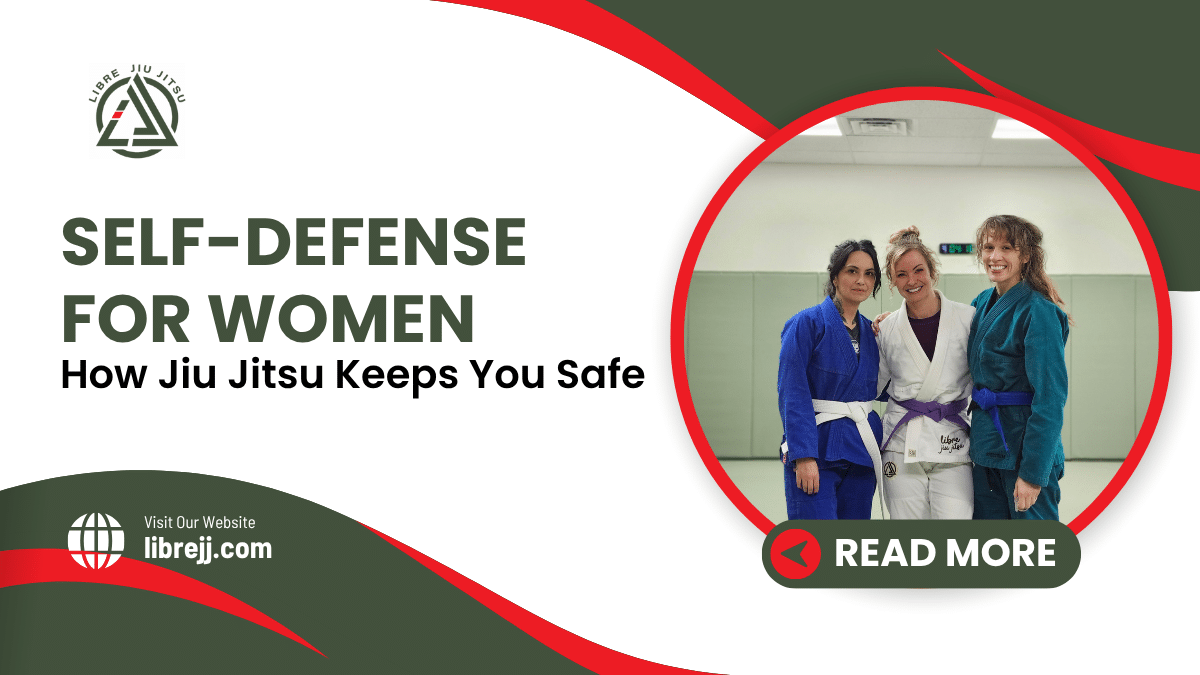
Libre Jiu Jitsu runs dedicated women’s classes alongside our mixed adult BJJ classes and kids programs at our academy in Farmers Branch. Whether you are searching for BJJ near me from Carrollton, Addison, North Dallas, or anywhere in the surrounding North Texas area, we sit right off I-35E at Valley View Lane, easy to reach from most nearby neighborhoods.
Here is what our women’s program is built around:
- Female-only class times. Some women prefer to start in an all-women environment before crossing over to mixed classes. Both options are always available.
- Female instructors and coaches involved in curriculum. Women learn differently, communicate differently, and often ask different questions. Our coaches understand this and adjust accordingly.
- A no-ego culture that starts at the top. Our owner and head instructor sets a tone of respect and patience. That tone is enforced. Aggressive behavior gets addressed, not tolerated.
- Full curriculum, not watered-down self-defense. Our women’s classes cover the same complete Jiu Jitsu system as our other classes. You are learning real BJJ, not a simplified version.
- Gi and no-gi grappling included. You get exposure to both training formats over time, which builds a more complete skill set for real-world situations.
We also welcome new women into our mixed adult BJJ classes and self-defense focused women’s BJJ training in Farmers Branch, which is where many students choose to train once they get comfortable.
To read more about what draws so many women to the sport locally, check out our breakdown on why more women across North Dallas are training Jiu Jitsu and what has changed for them.
Curious about what your very first class will feel like from the moment you walk in? We wrote a full walkthrough of what your first Jiu Jitsu session actually feels like to remove all the guesswork.
Not sure what to wear? Here is our simple guide to what to wear to your first class, including options that work whether you have Gi gear yet or not.
Our flexible BJJ memberships are structured to work around real life (monthly, three-month, and six-month options) and our full weekly BJJ class times show exactly when women’s classes, mixed classes, kids programs, and open mats run.
Brazilian Jiu Jitsu for beginners Dallas has offered has never been more accessible, and Farmers Branch martial arts training now includes options built specifically for women who want real skill, real fitness, and real safety, not just a workshop.
Frequently Asked Questions
Is BJJ self defense really effective for women in real situations?
Yes, and it is arguably the most effective system available. Jiu Jitsu was invented specifically to give smaller, physically weaker people a way to defeat larger, stronger opponents. That premise is exactly what women’s self defense needs to solve for.
How long before Jiu Jitsu becomes useful for actual self defense?
You will have usable skills within 90 days of consistent training (two to three classes per week). Real fluency comes at the one to two year mark. Long term, most women describe a permanent shift in how they carry themselves and how they respond to pressure.
Do I have to compete or spar hard?
No. Rolling (practice sparring) is a normal part of class, but you control the intensity. Many women train for years and never enter a single competition. Others eventually love the challenge. Both are valid paths.
What if I have never done any martial art or contact sport before?
That describes the majority of new students. Zero prior experience is completely fine. Our beginner curriculum assumes you are starting from scratch.
Are there classes just for women, or do I have to train with men?
Both options exist. We run dedicated women’s classes for those who prefer that environment, and mixed classes are open to everyone. Many women start in women’s-only classes and eventually train in both.
Will I get hurt?
Bruises and soreness are normal. Serious injuries are rare because Jiu Jitsu has no striking. Compared to running, cycling, or team sports, the injury rate is very low.
How much does it cost?
Costs vary by membership length and structure. Longer commitments cost less per month. Our free trial week lets you try everything before committing to a membership at all.
Can I really start with a free trial?
Yes. Libre Jiu Jitsu offers a full free trial week with access to women’s classes, mixed classes, adult BJJ classes, and open mat time. No commitment, no sales pressure, just real training so you can see if it fits.
Where is your gym located?
We are located at 13150 Senlac Drive, Suite 190, Farmers Branch, TX 75234, right off I-35E at Valley View Lane. Reach us at (972) 587-0488.
Ready to Take Back Your Sense of Safety?
You do not have to keep living with the mental math. You do not have to accept that awareness is the best you can do. The gap between “aware” and “actually equipped” is closed in the training room, one class at a time.
Our free trial week gives you seven full days of access with zero commitment. Try a women’s class. Try a mixed adult class. Try both. See what it feels like to walk into a training room, do something hard, and walk out slightly more capable than you were the day before.
That feeling is what self defense actually is. Everything else is preparation for that feeling.
Libre Jiu Jitsu 13150 Senlac Drive, Suite 190 Farmers Branch, TX 75234
Phone: (972) 587-0488
Serving Farmers Branch, Carrollton, Addison, and the broader North Dallas area. Located right off I-35E at Valley View Lane.
Book your free trial week today and step onto the mat.