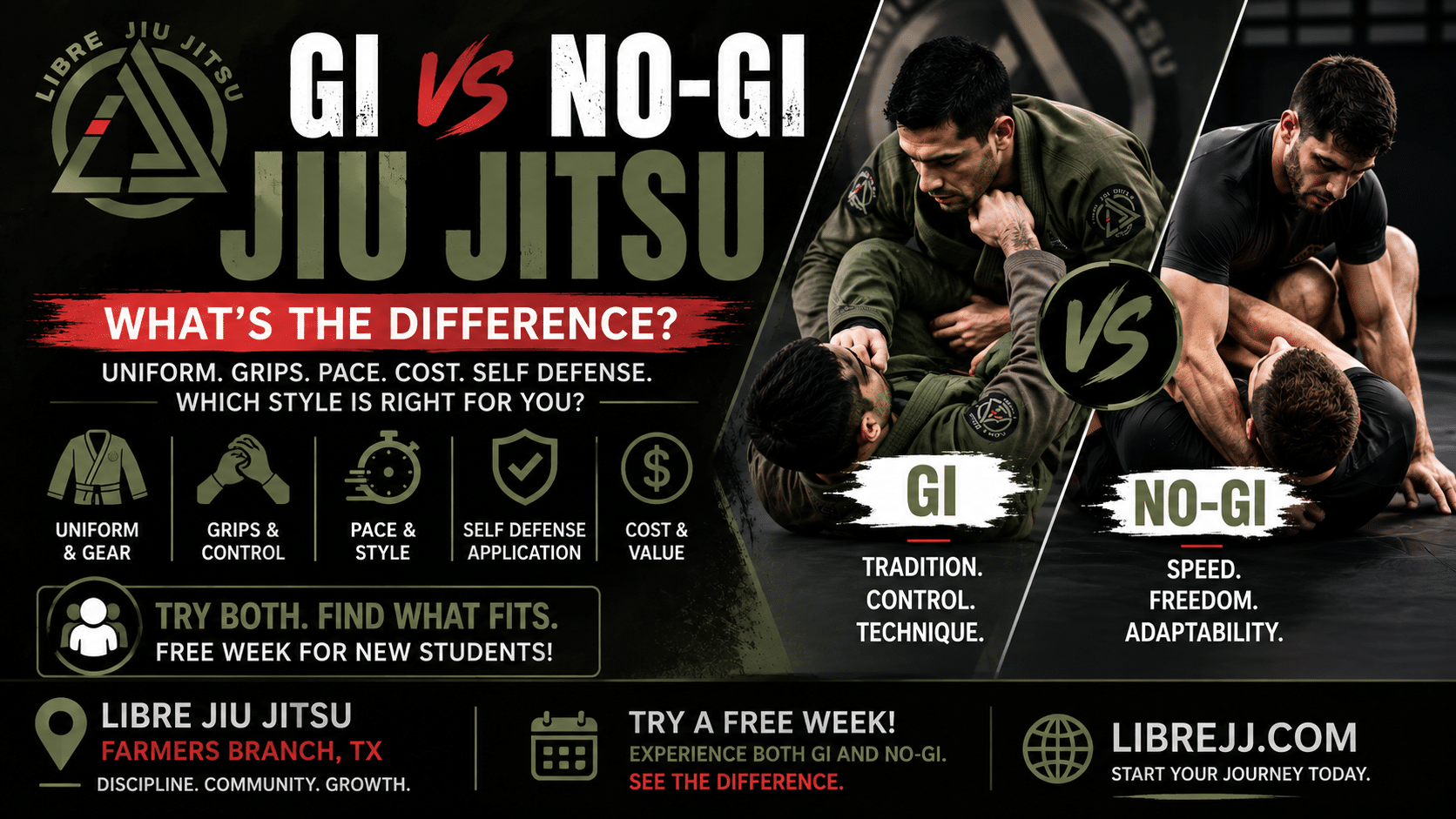
Walk into any legitimate BJJ academy and you will hear two words tossed around constantly: Gi and No-Gi. To an outsider, they sound like different martial arts. In reality, they are two sides of the same coin, and both are pillars of modern Brazilian Jiu Jitsu.
If you have been researching adult BJJ classes in Farmers Branch, Dallas, or the broader North Dallas area, you have probably run into videos of practitioners in traditional kimonos, and then other videos of the same athletes rolling shirtless in fitted shorts. Same sport. Very different feel.
This guide breaks down exactly what separates Gi from No-Gi Jiu Jitsu: the gear, the grips, the pace, the cost, and how each style translates to real self defense. Whether you are brand new to grappling or trying to decide where to start, you will finish this article knowing which lane fits you first. We will also cover how our free trial BJJ Dallas offer at Libre Jiu Jitsu lets you try both formats before you commit to anything, so you can feel the difference for yourself instead of guessing.
Gi Jiu Jitsu, Explained Simply
What the Gi Actually Is
The Gi (sometimes called a kimono) is the traditional uniform of Brazilian Jiu Jitsu. It is a heavy, reinforced cotton jacket, matching pants, and a colored belt that marks your rank. The fabric is stiff by design. Every seam, collar, sleeve, and lapel is built to be grabbed, pulled, twisted, and used as a lever.
Gi Jiu Jitsu is the version most people picture when they think “Brazilian Jiu Jitsu.” It traces directly back to the Gracie family’s system in Brazil and remains the dominant format in traditional academies worldwide.
How the Gi Changes the Game
The uniform is not costume, it is equipment. Wearing a Gi fundamentally rewires how a round of BJJ plays out:
- Slower pace. Grips are sticky, sweat gets absorbed, and friction between two Gis makes explosive scrambles harder to pull off.
- More control positions. You can grip a collar, a sleeve, or a pant leg and hold someone in place while you set up your next move.
- More submission variety. Chokes using the collar (cross collar choke, bow and arrow, ezekiel) simply do not exist without the jacket.
- Higher technical ceiling. Because there are so many more attachment points, the strategic depth of Gi rolls is enormous. Every grip is a decision.
For Brazilian Jiu Jitsu for beginners Dallas and beyond, Gi training is often recommended first because the slower pace gives you time to think, feel, and correct your position mid-roll instead of getting swept up in a scramble.
No-Gi Jiu Jitsu, Explained Simply
What “No-Gi Grappling” Really Means
No-gi grappling is Brazilian Jiu Jitsu practiced without the kimono. Instead of a Gi, you wear a fitted rash guard on top and shorts (often called grappling shorts or board shorts). Some academies allow spats (compression tights) underneath.
The rules and objectives are the same as Gi: control your opponent, advance position, finish with a submission. What changes is everything you can grab.
No-gi is also sometimes called submission grappling, and it is the format used in ADCC, EBI, and most modern MMA training. If you have watched a UFC ground exchange, you have watched no-gi principles in action.
How No-Gi Changes the Feel
Strip the jacket off and Jiu Jitsu becomes a different beast:
- Faster pace. Without cloth to slow you down, movement is quicker and rounds feel more like wrestling with submissions layered on top.
- Sweat matters. As you get tired, your body becomes slippery. Holding position takes actual physical control, not just a good grip.
- Grip changes. Instead of collars and sleeves, you grip the neck, wrists, ankles, and underhooks (an arm hooked under the opponent’s armpit).
- Different submission menu. Chokes shift toward guillotines, rear naked chokes, and D’arces. Leg locks (heel hooks, kneebars, straight ankle locks) play a much larger role.
If you like an athletic, wrestling-influenced style that translates directly to real-world scenarios where nobody is wearing a Gi, no-gi is where you will feel at home.
Gi vs No-Gi: The Side-by-Side Breakdown
Here is exactly how the two styles compare on the details that matter most to a new practitioner. Read each row as a mini-comparison card.
Uniform and Gear
- Gi setup: Kimono jacket, matching pants, colored belt. Barefoot.
- No-Gi setup: Fitted rash guard, grappling shorts, optional spats. Barefoot.
- Bottom line: The Gi is heavier, hotter, and more expensive up front. No-Gi gear is lighter, cheaper, and dries faster after class.
Grips and Control
- Gi grips: Collar, sleeve, pant leg, belt, and lapel. All fabric-based.
- No-Gi grips: Wrists, neck, ankles, underhooks, overhooks, head control. All flesh-and-bone.
- Bottom line: Gi grips are stickier and more forgiving. No-Gi requires you to physically clamp down using leverage and body positioning, which builds different muscles and instincts.
Pace and Athleticism
- Gi pace: Slower, more chess-like, methodical.
- No-Gi pace: Faster, more scrambly, more explosive.
- Bottom line: Gi rewards patience and strategy. No-Gi rewards timing, conditioning, and reflexes. Neither is “harder,” they simply reward different traits.
Techniques and Submissions
- Gi favorites: Collar chokes (cross collar, bow and arrow, ezekiel), lapel guards (worm guard, lasso), spider guard.
- No-Gi favorites: Guillotines, rear naked chokes, D’arces, heel hooks, kneebars, leg entanglements.
- Bottom line: Roughly 70 percent of what you learn transfers between the two. The remaining 30 percent is style-specific and worth learning separately.
Cost to Start
- Gi cost: A quality beginner Gi runs $80 to $150. You typically want two so you always have a dry one.
- No-Gi cost: A rash guard and shorts combo runs $50 to $90 total.
- Bottom line: No-Gi has a lower barrier to entry, but a Gi lasts years and pays for itself quickly.
Hygiene and Care
- Gi care: Wash after every class, hang dry, do not bleach colored Gis, watch for shrinkage.
- No-Gi care: Wash after every class, machine dry is usually fine, replace rash guards yearly if training hard.
- Bottom line: Both are equally hygienic if you actually wash your gear. The Gi just takes longer to dry.
The Beginner’s Question: Which Should You Start With?
This is the single most common question walked into any BJJ academy: “Do I start Gi or No-Gi first?”
There is no universal answer, but there are strong guidelines. Traditional academies (and most instructors with black belts) will tell you to begin with the Gi. Here is why:
- The Gi slows the game down. As a beginner, you need time to feel positions, recognize mistakes, and correct them. The friction of the Gi buys you that time.
- Grip fighting teaches problem solving. Learning to break grips, establish grips, and use grips defensively builds the foundational awareness that carries into no-gi later.
- Belt structure gives you clear progression. Watching your belt change color over the years is a powerful motivator that no-gi does not offer in the same way.
- Most academies teach fundamentals in the Gi. If you skip Gi, you may skip the entire base curriculum.
That said, if you have a wrestling background, or your only goal is MMA, or you genuinely hate the idea of wearing a kimono, no-gi is a perfectly valid starting point. Plenty of world class grapplers started no-gi first and never regretted it.
The gi vs no gi for beginners debate ultimately comes down to what will keep you showing up. The best style is the one you will actually train consistently.
Gi Pros and Cons
Where the Gi Wins
- Deeper technical library. More grips means more setups, sweeps, and submissions to learn.
- Slower rolls mean fewer injuries early on. Beginners get hurt less when they are not scrambling at full speed.
- Belt promotions. A visible, respected ranking system built into the uniform.
- Traditional culture. Bowing, etiquette, and lineage are more present in Gi environments.
- Transfers well to older training partners. The grip-based game does not require athletic explosion, so training with people twice your age is completely realistic.
Where the Gi Falls Short
- Uniform cost. Two solid Gis will run you $200 or more.
- Hotter to train in. In Texas summers, a Gi becomes a personal sauna quickly.
- Longer wash cycles. Two hour wash and dry turnaround minimum.
- Techniques that only exist inside the Gi. Some grips (lasso guard, worm guard) do not translate to no-gi or self defense at all.
No-Gi Pros and Cons
Where No-Gi Wins
- More directly applicable to self defense. Nobody attacks you in a kimono. The grips you use in no-gi (wrist, neck, underhooks) work in a t-shirt or a jacket or bare skin.
- Better crossover to MMA. Every UFC ground exchange is fundamentally no-gi.
- Cheaper to start. A rash guard and shorts cost less than a single Gi.
- Faster paced conditioning. You will gas out fast at first, then build serious cardio.
- Less to wash. Rash guards air dry in an hour.
Where No-Gi Falls Short
- Steeper learning curve for pure beginners. Without grips to slow the game down, new students often feel like they are drowning.
- Higher injury risk from scrambles. Fast pace plus slippery sweat plus leg locks means more small tweaks and strains.
- Less structured ranking. Belts still exist, but promotions often move slower without Gi-specific curriculum.
- Leg lock heavy modern game. If you dislike attacks below the waist, modern no-gi may frustrate you.
Which Style Fits Your Goals?
Rather than asking “which is better,” ask “which fits me right now.” Here is a goal-based selector to help you decide.
If your goal is real world self defense
Start with No-Gi as your primary focus, but train Gi at least once a week for grip strength and control. Attackers on the street wear jeans and t-shirts, not kimonos. That said, the Gi still teaches you how to use somebody’s clothing against them, and that skill has real self defense value if the person attacking you happens to be wearing a jacket. This is one reason self-defense Dallas seekers benefit from training both formats even if they lean no-gi.
If your goal is sport competition
Pick a lane based on the tournaments you want to enter. IBJJF, NAGA, and most local circuits offer both. Elite competitors typically train both formats and pick their poison in tournament season. Beginners should focus on one for the first 12 to 18 months to build a base before splitting attention.
If your goal is MMA
No-Gi is the priority. Every second on the ground in an MMA fight is a no-gi second. But top MMA grapplers still cross-train in the Gi because grip fighting builds hand strength and defensive awareness you cannot get any other way.
If your goal is fitness and stress relief
Either works. No-Gi burns more calories per round because of the pace. Gi rewards long, methodical training sessions. Try both and pick whichever leaves you smiling in the parking lot after class.
If your goal is longevity
The Gi is easier on your joints in the long run because of the slower pace. Older students (40 plus) often gravitate toward Gi for this reason, but plenty of no-gi lifers stay healthy well into their 50s and 60s by managing training intensity.
Self Defense: Which One Actually Prepares You for the Street?
This is the most emotionally charged debate in BJJ, and both camps have strong points. Here is the honest breakdown.
The case for Gi as self defense
Real world attackers usually wear clothes. Jackets, hoodies, and t-shirts all offer grippable material. If somebody grabs you from behind or bear hugs you in a parking lot, being comfortable with fabric grips gives you options no-gi students do not have. Gi training also builds enormous grip strength, which is the single most predictive attribute of ground survival.
The case for No-Gi as self defense
Sweat, panic, and adrenaline make skin slippery. If an attacker is not wearing a Gi (nobody is), you need to be comfortable controlling somebody using body positioning, not fabric. No-Gi trains that reflex directly. Additionally, no-gi practitioners tend to develop faster, more explosive movement, which matters in a real confrontation where seconds count.
The honest answer
For the average adult trying to be safer in Farmers Branch, Dallas, or anywhere else, the best answer is to train both, but weight no-gi slightly heavier if pure self defense is your main goal. The overlap between the two is around 70 percent, so training both is not double the work. It is closer to 130 percent of the value for 100 percent of the effort.
Almost every self defense scenario worth training for involves standing up, closing distance, taking somebody down, and controlling them until you can safely disengage. Both Gi and No-Gi teach exactly that.
Training Both: The Smart Long-Term Path
Here is what most serious practitioners eventually figure out: the Gi versus No-Gi debate is a false choice. The best BJJ athletes in the world train both.
Training both formats gives you:
- Grip strength from the Gi that makes no-gi control feel effortless.
- Scramble reflexes from no-gi that make Gi transitions faster and cleaner.
- A wider submission library that keeps opponents guessing.
- Better conditioning because you experience both slow methodical rolls and fast athletic ones.
- More scheduling flexibility since you can attend more classes per week without repeating the same format.
The traditional recommendation is 60/40 or 70/30 in favor of the Gi during your first two years, then rebalancing based on your goals. If you are competing no-gi, flip the ratio during camp. If you are prepping for a Gi tournament, do the opposite.
At Farmers Branch martial arts academies that take training seriously, both formats appear on the weekly schedule. This is exactly how we structure things at Libre Jiu Jitsu.
What Adult BJJ Classes Look Like at Libre Jiu Jitsu
Our academy in Farmers Branch runs a full weekly schedule of both Gi and No-Gi training for adults, along with kids programs and dedicated women’s classes. If you are searching for BJJ near me from anywhere in North Dallas, Carrollton, or Addison, we sit right off I-35E at Valley View Lane, so you can be on the mat within 15 minutes of most surrounding neighborhoods.
Here is what to expect from our adult BJJ classes at our Farmers Branch academy:
- Mixed Gi and No-Gi weekly. You do not have to choose. Try both under one membership.
- Fundamentals-first approach. New students get a curriculum that actually teaches, not a “throw them into rolling” sink or swim environment.
- Ego-free training room. Our coaches set the tone. Nobody at Libre is out to prove themselves at your expense.
- All experience levels welcome. Complete beginners train alongside experienced belts. Everyone helps everyone learn.
Not sure what a class looks like from the inside? Here is a full walkthrough of what a first BJJ class actually looks like so you can walk in with confidence.
And if you are wondering what to bring, we put together a simple guide on what to bring to a first Jiu Jitsu class so nothing catches you off guard.
Women considering the mat can also read our breakdown of why more women in North Dallas are stepping onto the mat and what to expect in our women-only sessions.
We offer flexible BJJ memberships (monthly, three-month, six-month) so you can commit at your own pace, and our full weekly BJJ class schedule shows exactly when Gi, No-Gi, kids, and women’s classes run.
Frequently Asked Questions
What is No-Gi Jiu Jitsu in one sentence?
No-Gi Jiu Jitsu is Brazilian Jiu Jitsu practiced in a rash guard and shorts instead of the traditional kimono, with a faster pace and grips based on the body rather than the uniform.
Is No-Gi harder than Gi?
Neither is objectively harder. No-Gi is more physically demanding early on because of the pace and the lack of grip anchors. Gi is more technically dense because of the sheer number of grips and setups. Most beginners find Gi easier to survive in during the first few months.
Do I need a Gi to start training at Libre Jiu Jitsu?
No. New students can start in a rash guard and shorts, and you can borrow gear for your first session if needed. Once you commit, most students purchase a Gi within the first two weeks so they can attend both class formats. We have gear recommendations available at the front desk.
How long does it take to feel comfortable in No-Gi?
Most beginners feel comfortable inside three months of consistent training (two to three classes per week). By six months, no-gi will feel like a completely normal environment.
Which one should I choose if I only want self defense?
Prioritize no-gi, but cross-train Gi at least once a week if possible. Self defense scenarios rarely involve fabric grips, but the grip strength and body awareness from Gi training make you a better all-around grappler.
Can I compete in both?
Yes. Most tournaments (NAGA, IBJJF, Grappling Industries) offer separate Gi and No-Gi divisions. Many competitors enter both on the same day.
Does Libre Jiu Jitsu offer a trial before signing up?
Yes. Libre Jiu Jitsu offers a full free trial week with access to Gi, No-Gi, and any other class on the schedule you want to try. You can experience both formats before committing to anything.
Where is your gym located?
We are located at 13150 Senlac Drive, Suite 190, Farmers Branch, TX 75234, right off I-35E at Valley View Lane. Reach us at (972) 587-0488.
Ready to Feel the Difference for Yourself?
Reading about Gi vs No-Gi Jiu Jitsu will only take you so far. The best way to understand the two styles is to feel each of them, back to back, on a real mat with real training partners.
That is exactly what our free trial week is for. No pressure, no long term commitment, just seven days of full access to Gi classes, No-Gi classes, adult BJJ classes, kids programs, and women’s sessions. Come try one format, come try both. See which one clicks.