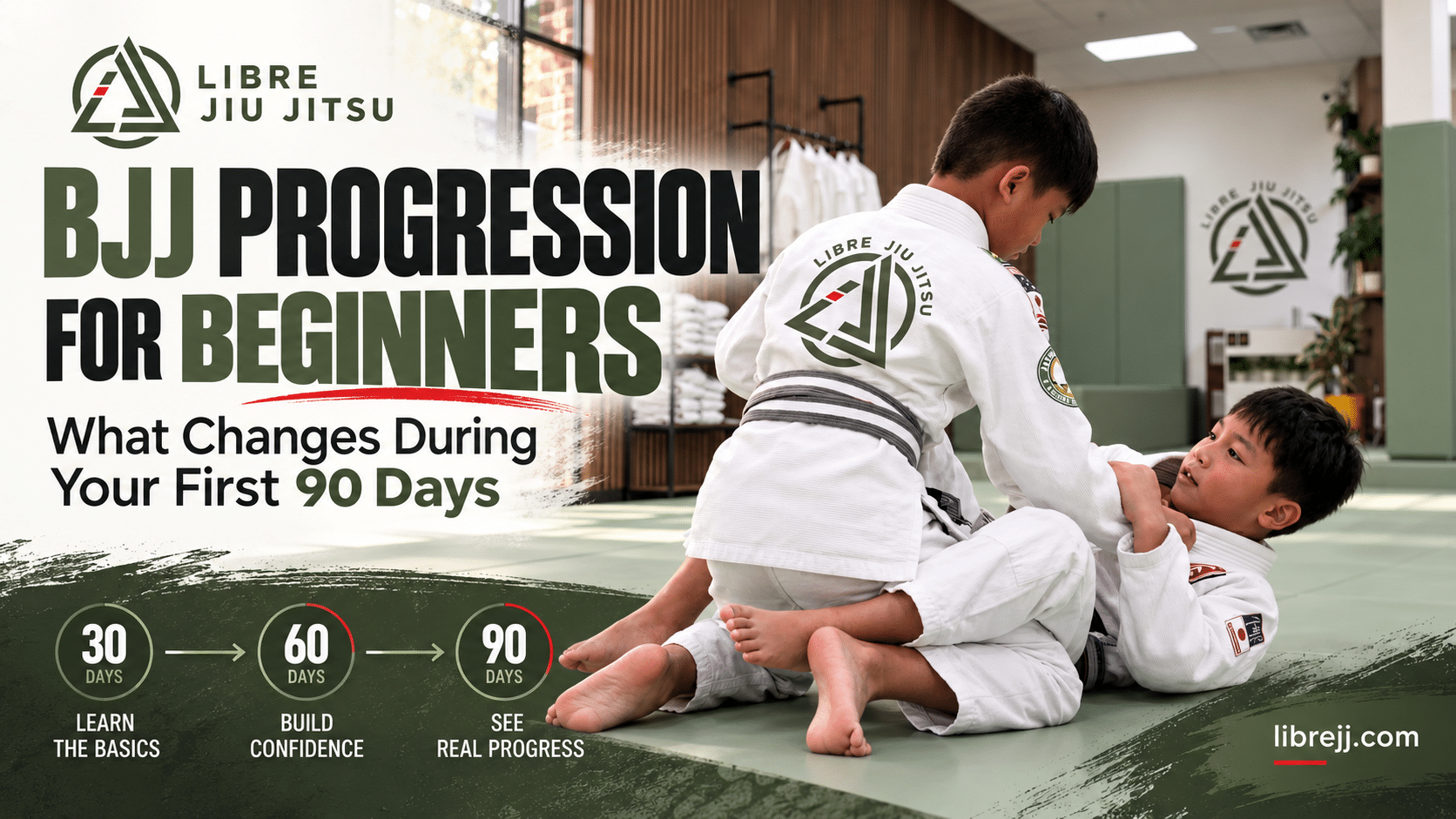
Most people thinking about BJJ hear plenty about the first class. Almost nobody talks about the next three months.
Starting Brazilian Jiu Jitsu is one thing. Understanding what actually happens to your body, your mind, and your skills over the next three months is something else entirely. Most beginners in the Dallas area never hear about this part. They hear about the first class, sure. But nobody tells them what the weeks between that first class and month three actually feel like, what changes when, and why so many beginners quietly quit right before the whole thing starts to click.
If you are just getting started, Libre Jiu Jitsu offers a free trial week of BJJ classes so you can experience the training without a commitment. And if you have not walked through the door yet, our breakdown on what to expect at your first Jiu Jitsu class covers everything from what to wear to how the room works.
This post picks up right after that first class and walks you through exactly what changes during your first 90 days of BJJ training, month by month, week by week.
Why the First 90 Days Matter More Than Any Other Window
Here is something most academies will not tell you: the hardest part of BJJ for beginners is not learning a rear naked choke or passing someone’s guard. The hardest part is showing up during the stretch of weeks when nothing seems to make sense and your body is not cooperating.
That stretch is the first 90 days.
A lot of people who quit do it in the first few months. Not because the training is too hard. Not because they got hurt. Because they expected linear progress and got something that felt more like organized confusion. They thought they should be “getting it” by week three, and when they were not, they assumed the problem was them.
BJJ has a longer learning curve than most physical activities. The first 90 days are the foundation phase, where your body learns movements it has never done, your brain absorbs a vocabulary it has never heard, and your nervous system rewires itself to handle the discomfort of close physical contact and controlled pressure. None of that happens fast. But all of it happens, and it compounds in ways that become obvious around month three.
Understanding this timeline in advance is the single biggest predictor of whether a beginner sticks around long enough to experience the real benefits of training.
Before Day One: What You Are Walking Into
Brazilian Jiu Jitsu is a grappling martial art with no punching, no kicking, and no striking of any kind. You learn to control another person using leverage, angles, and body position, and you learn to submit them using joint locks and chokes that force them to tap out.
Training is partner-based from the very first session. You will drill techniques with another person, practice positions with another person, and eventually spar (called “rolling”) with another person. The entire art is built on cooperative learning and mutual respect.
A few things that catch beginners off guard:
The physical contact is close: BJJ puts you chest to chest, hip to hip, and face to face with training partners. This is uncomfortable at first for almost everyone. It stops being uncomfortable surprisingly fast.
The positions have names: Guard. Mount. Side control. Half guard. Back control. These are the geography of BJJ, and learning them is like learning a new map. You will not memorize it overnight, and you are not supposed to.
You will not spar right away: Most schools, including ours at Libre Jiu Jitsu in Farmers Branch, introduce live rolling gradually. Your first few weeks are drilling and positional work so you have a baseline understanding before adding the chaos of a resisting partner.
You are going to be confused: This is normal. It does not mean you are bad at this. It means you are new.
Days 1 Through 30: Learning the Language
What You Will Recognize
By the end of your first month, you should be able to name three to four positions on sight. Guard, mount, side control, and maybe back control will start to feel like real places rather than abstract words.
You will learn a hip escape (also called a shrimp). You will learn a bridge. These two movements are the foundation of every escape and every positional transition in the entire art, and you will practice them hundreds of times during your first 30 days.
You will also start drilling two to three techniques, maybe a basic guard pass, a simple sweep, or an escape from mount. The goal is not perfection. The goal is familiarity. You want the movement pattern to live in your body so it can fire without you thinking through every single step.
What Will Feel Hard
Everything.
The vocabulary is overwhelming. You will leave class unsure if you learned anything. You will watch a technique demonstrated five times and still feel lost when you try it with a partner. Your body will not cooperate. Your cardio will betray you. You will use too much strength because you do not yet have the technique to replace it.
All of this is standard. Every person who trains BJJ, from white belt to black belt, went through this exact phase.
What to Focus On
Show up consistently: Two to three classes per week is the sweet spot for beginners. Less than two and the learning gaps between sessions become too wide. More than three and your body will not recover, which slows progress instead of accelerating it.
Do not try to win: You are not competing. You are learning. The difference matters.
Ask questions: Coaches and upper belts want you to ask. The question you are afraid to ask is usually the one that unlocks the next step.
Pay attention to the warm-up: Those movement drills (shrimping, bridging, rolling, technical stand-ups) are not just cardio. They are the mechanical foundation for every technique you will learn. Treat them like practice, not a prelude.
Days 30 Through 60: The Ego Window
What Starts to Click
Around month two, the chaos starts to organize. You can recognize six to eight positions, and more importantly, you can start to see how they connect. Mount is not just mount. It is the position you end up in after passing someone’s guard. Side control is not just pressure. It is the launching pad for attacks. The hierarchy of positions begins to make sense: top is generally better than bottom, back control is the best position in the art, and guard is the most versatile.
You will start to understand the basic flow of a roll. Someone passes your guard, they establish side control, they work toward mount or back control, they look for a submission. Knowing this sequence, even when you cannot stop it, changes the way you move. You start to anticipate rather than react.
You will also land your first intentional submission in a light roll. Maybe an armbar from guard, maybe a cross-collar choke. It will feel like a genuine accomplishment, because it is.
What Gets Harder
This is the window where your ego takes the biggest hit. You will get submitted by training partners who are smaller, lighter, and less athletic than you. They have one thing you do not have yet: time on the mat.
A 140-pound blue belt with two years of training will make a 200-pound brand-new white belt feel helpless. This is not a bug of BJJ. It is the feature. It proves the art works. Leverage beats strength. Technique beats athleticism. Position beats power. But knowing this intellectually and experiencing it on the mat are very different things.
This is the window where most people quit. The beginner novelty has worn off. The gap between you and everyone above you is painfully visible. And the wins are still rare enough that the effort can feel pointless.
It is not pointless. The shift at day 90 is coming, and it does not go backward.
The Three Ego Traps That Wash Out Beginners
Trap one: Trying to win every roll
New white belts treat rolling like a competition. They muscle through every position, gas out fast, and learn nothing because survival mode shuts down the part of the brain that absorbs technique. The students who progress fastest do the opposite. They pick one or two techniques per week to try during live rolling, accept getting submitted while they work those techniques, and rebuild on each tap. They lose more rolls in month one and dominate by month six.
Trap two: Chasing fancy techniques instead of drilling fundamentals
The internet is full of highlight-reel submissions that look like the answer to everything. New students try them in rolling and get crushed by simple fundamentals from anyone with six months of experience. The foundation that actually works long-term is posture, base, frames, escapes, guard retention, and basic top control. Everything flashy sits on top of those bricks. Skip the bricks and nothing else works.
Trap three: Comparing yourself to the wrong benchmarks
You will roll with a blue belt who makes you feel like progress is impossible. You will roll with another white belt who looks better than you and wonder why you are behind. Both comparisons are useless. The blue belt has two to three years on you. The other white belt might have a wrestling background, a natural athletic advantage, or three extra classes a week. The only useful comparison is you versus yourself 30 days ago. Track that. Ignore the rest.
Not sure you’re ready? Most of our members weren’t either. Our free trial week lets you take beginner classes at Libre Jiu Jitsu in Farmers Branch, ask the coaches anything, and see how it feels before you sign up. Book your free week here
Days 60 Through 90: Where It All Starts to Click
What Changes
Month three is the shift everyone talks about, and it is real.
You can roll with intent now. Not perfectly, not smoothly, but with a plan. You start from a position and you have an idea of where you want to go next. You see openings before they close. You recognize what your partner is trying to do as they do it, not after.
You will have a game plan from at least one position. Maybe you feel strongest from closed guard. Maybe you have developed a reliable escape from side control. Whatever it is, you have something that belongs to you, a piece of the art that you have internalized through repetition.
You will submit other white belts with some regularity. Not everyone, not every time, but enough that you can feel the skill gap between day-one-you and current-you.
And perhaps the most important change: you will start asking the right questions. Not “what do I do here?” but “why does this work from here and not from there?” That shift in questioning is a sign that your understanding of BJJ is deepening you’re starting to understand why things work, not just copying them.
The Realization That Keeps You Training
Around day 90, most beginners have a simultaneous realization that sounds contradictory but is actually the heart of the art.
You realize how far you have come. And you realize how much there is left to learn.
The technique tree in BJJ is enormous. Guard alone has dozens of variations, each with its own attack chains, sweep options, and defensive structures. You could train for a decade and still discover new layers in the same positions you learned during your first month.
This realization does one of two things. It overwhelms people who need a finish line, and those people leave. Or it energizes people who love the process of getting better, and those people stay for years.
The students who make it past day 90 almost never quit. The hook is set. The community has you. The skill development is visible and addictive. Welcome to BJJ.
What the Belt Timeline Actually Looks Like
Marketing from some commercial schools will promise fast belt promotions. If you’re new and wondering how long it takes to get a blue belt, here’s a realistic timeline.
White belt lasts roughly 1.5 to 2.5 years. During this time you are learning the language, surviving rolls, and building a baseline understanding of positions and submissions. Stripes come every few months as your fundamentals solidify.
Blue belt takes another 2 to 4 years after that. This is where you develop a personal game, start rolling with strategy, and can hold your own against most untrained people regardless of size. Blue belt is where you transition from student to practitioner.
Purple belt adds another 2 to 3 years. At this level, you can teach. You roll with intent and creativity. The deep technical understanding starts to show.
Brown belt takes another 1.5 to 2.5 years. Most people never get here. The black belt is real and visible from this point.
Black belt arrives roughly 8 to 12 years after you tie on your first white belt. It is the beginning of mastery, not the end of learning.
If a school promises you a blue belt in six months, what they are selling is not the BJJ that holds up under pressure. Real belt progression is slow on purpose. The slowness is what makes the skill real.
For a deeper look at how Gi and No-Gi training each contribute to this progression, our post on Gi vs No-Gi Jiu Jitsu breaks down the differences and when each approach makes sense for your development.
Beginner BJJ Tips for Your First 90 Days
Training Frequency
Two classes per week is the minimum to make consistent progress. Three classes per week is the sweet spot for your first year. Going beyond that as a brand-new beginner often leads to overtraining, which stalls progress rather than accelerating it. Your body needs recovery time to absorb what you are putting it through.
Quality beats quantity during this phase. Three focused classes where you drill with intent and ask questions will always outperform five exhausted sessions where you are just trying to survive the hour.
Recovery Is Not Optional
BJJ soreness is different from gym soreness. You are using muscles in unfamiliar patterns, absorbing pressure from training partners, and gripping with an intensity your forearms have never experienced. During the first few weeks, your hands will be sore from gripping the gi. Your neck will be sore from being controlled. Your hips will be sore from movements they are not used to.
This passes. Your body adapts. But only if you give it time. Sleep enough. Eat well. Stretch. The students who recover well progress faster than the students who train through exhaustion.
Drilling Versus Rolling
Beginners often want to jump straight into live rolling because it feels like “the real thing.” Drilling feels repetitive and boring by comparison. But drilling is where skill is actually built. Rolling is where you test it.
Think of drilling as learning the words and rolling as having the conversation. You would not try to debate someone in a language you learned three words of. The same logic applies here.
Most academies, Libre Jiu Jitsu included, structure classes to include both drilling and positional sparring. Trust that structure. The balance between controlled repetition and live application is what produces real progress during the first 90 days.
What to Wear and Bring
For your first class, athletic shorts without zippers or pockets (those catch fingers and tear gis) and a fitted shirt or rash guard work fine. Most schools will loan a gi for your initial sessions.
After that, plan on getting your own gi. A solid beginner gi costs between $80 and $150 and lasts for years. A mouthguard is optional for the first week or two but becomes useful once you start rolling. Bring a full water bottle. Clip your fingernails and toenails before every class (long nails scratch training partners and get caught in fabric). Shower before class. No jewelry on the mats.
What BJJ Does to Your Body in 90 Days
The physical changes during the first three months are significant, even if the mirror does not show them right away.
Cardiovascular fitness: Rolling is one of the most demanding cardiovascular activities available. Your heart rate spikes and drops repeatedly as you transition between explosive bursts and controlled technical positions. This interval-style conditioning builds endurance fast.
Grip strength: BJJ practitioners develop grip strength that surprises people from other athletic backgrounds. Constant gripping of the gi, your partner’s sleeves and collars, and the mat itself builds forearm and hand strength in ways that transfer to every other physical activity.
Core engagement: Your core is active during every second of every roll. Maintaining posture, defending sweeps, generating movement from your hips, and resisting pressure from top positions all demand constant core engagement. This builds functional core strength that planks and crunches cannot replicate.
Hip mobility: Guard work requires hip flexibility that most adults do not have when they start. Within 90 days, most beginners notice significantly improved hip mobility without any dedicated stretching program. The positions themselves build the range of motion.
Body awareness: BJJ teaches you where your body is in space in a way that no gym workout can match. You learn to feel weight shifts, anticipate pressure, and control your limbs in relation to another moving body. This spatial awareness carries over into everything from everyday balance to injury prevention.
The Mental Side: What 90 Days of BJJ Does to Your Head
The physical benefits get most of the attention, but the mental shifts are just as significant.
Stress processing changes
BJJ demands complete presence. You cannot think about work, bills, or your phone while someone is actively trying to submit you. This forced mental engagement acts like a hard reset on stress. Students consistently report leaving the mat feeling clearer and calmer than when they arrived.
Problem-solving under pressure
Every roll is a real-time puzzle with a moving, resisting opponent. You learn to think when you are tired, uncomfortable, and at a positional disadvantage. That composure transfers directly into how you handle pressure at work and in your personal life.
Relationship with failure changes
Once you start rolling, you’ll get tapped a lot. That’s how everyone learns. There is no hiding from failure in BJJ, and that repetitive exposure to losing rewires how you process setbacks. Getting tapped stops being a defeat and starts being information. That mindset shift is one of the most valuable things the art produces.
Confidence grows from competence
The confidence that BJJ builds is not the hollow, motivational-poster kind. It is earned through verifiable skill development. You know you can defend yourself because you have done it against resisting partners. You know you can handle discomfort because you have sat in bad positions and worked your way out. That kind of confidence is quiet, stable, and real.
Beginner BJJ in Dallas: Training at Libre Jiu Jitsu
At Libre Jiu Jitsu, we run beginner-friendly Brazilian Jiu Jitsu classes six days a week at our Farmers Branch location, right off I-35E and Valley View Lane. Our adult BJJ program is designed for people who have never stepped on a mat before, and our coaches prioritize fundamentals, safety, and steady progression over flashy technique.
The culture here is straightforward: ego stays at the door, technique wins over strength, and every student trains at their own pace. Whether you are 25 or 55, athletic or out of shape, you will find your footing during the first 90 days because the program is built to meet you exactly where you are.
Our guide to starting Jiu Jitsu as an adult covers fitness worries, what the room is like, and more. It covers everything from fitness concerns to the culture of the training room.
Frequently Asked Questions About BJJ for Beginners
How long until BJJ stops feeling overwhelming and the positions start clicking?
For most people, the positions start organizing in your head around week 8 to week 12. Before that, everything feels like noise. Around month three, patterns emerge and the map starts to make sense. By month six, you will have a basic game from at least one or two positions. The overwhelming feeling is not a sign that something is wrong. It is a sign that your brain is absorbing a complex new skill.
Do I need to be in shape before starting BJJ?
No. BJJ fitness is different from gym fitness, running fitness, or any other kind of fitness. The specific cardio demands of rolling, the grip endurance, the hip mobility: all of it develops through training, not before it. You will be in significantly better BJJ shape at day 90 than at day one, and it happens by showing up, not by pre-training.
Will I get injured training BJJ as a beginner?
Soreness and bruises are normal and expected. Real injuries are uncommon in a well-run academy because there is no striking. The most common beginner complaints are sore fingers (from gripping), stiff necks (from being controlled), and occasional rib soreness (from pressure). The single biggest injury prevention tool is tapping early and often. If something hurts or feels tight, tap. Reset. Go again. The students who train for decades are the ones who learned to tap fast during their first 90 days.
How often should I train as a beginner?
Two classes per week is the minimum for consistent progress. Three is ideal for most adults during their first year. More than three per week and recovery becomes the bottleneck, not skill development. At Libre Jiu Jitsu, our schedule runs six days a week with classes on weekday evenings and Saturday afternoons, so fitting two to three sessions into a busy week is straightforward.
Should I start in Gi or No-Gi?
Start in Gi. The gi forces slower, more technical exchanges that build your fundamentals cleanly. No-Gi is faster and more athletic, which often lets beginners get away with using strength over technique, a habit that hurts you long-term. Most people eventually train both. Gi-first builds the stronger technical foundation.
What if I am over 40? Is it too late to start BJJ?
Absolutely not. Some of the most consistent long-term practitioners started in their 40s and 50s. The art was designed around leverage, not raw athleticism, which is why age does not disqualify you. Train smart, tap early, prioritize recovery, and you can train for the next 20 or 30 years.
Your First 90 Days Start With Day One
The first 90 days of BJJ are not comfortable. They are confusing, humbling, and slower than your expectations will prepare you for. But they are also the window where you build the foundation for everything that comes after: the skill, the fitness, the confidence, the community, and the lifelong engagement that keeps black belts training decades after they first tied on a white belt.
Most people who push through to month four stay for years. The ones who quit almost always quit before that threshold.
The question is not whether you can do this. You can. The question is whether you will give yourself 90 days to find out.
Book your free trial week at Libre Jiu Jitsu in Farmers Branch and start your first 90 days. We are located at 13150 Senlac Drive, Suite 190, Farmers Branch, TX 75234, right off I-35E and Valley View Lane. Call us at 972-587-0488 or stop by any of our weekday evening or Saturday classes.
Your first class is the hardest one to book. Everything after that gets easier.