If you have found yourself typing “what age can kids start jiu jitsu” into a search bar, you are almost certainly in one of two situations. Either you have a preschooler bouncing off the walls and you want to know if they are old enough, or you have a nine or ten year old and you are worried you have already missed the window. Both are normal. Both have a straightforward answer.
Here is the honest version, which most articles dance around: the number on the sign-up sheet matters far less than whether your child is developmentally ready. A five year old who’s ready will have a blast. A seven year old who isn’t quite there yet will have a rough time regardless of age. Age is a rough guide, not a rule.
This guide gives you a clear, age-by-age breakdown of what training looks like at each stage, an actual readiness checklist you can use tonight, and the honest truth about starting late (spoiler: you have not missed the window). If you are anywhere in Farmers Branch, North Dallas, Carrollton, or Addison, the easiest way to settle it is to just come try it. Libre Jiu Jitsu is right off I-35E and Valley View Lane, and your child’s first week of classes is a free trial, with nothing to sign and no commitment.
The Short Answer
Most academies, including ours, start kids at age five. Some accept four. A few wait until six. That range exists because five is roughly when a typical child can follow a group instruction, share space with strangers, and get through a forty-five minute class without falling apart.
But the number is only half the picture. The other half is whether your specific child is ready right now. Some four year olds are more ready than some seven year olds. That is why we recommend the readiness checklist below over a birthday.
The Readiness Checklist That Actually Predicts Success
Before you look at ages, look at your child. Can they:
- Follow a thirty second instruction from an adult who is not you? If they are already in preschool or kindergarten, they probably can.
- Share space with other kids without getting territorial or upset?
- Handle being told “wait” or “not yet” without a full meltdown? Be honest with yourself here.
- Take turns for a minute while another child practices with the coach?
- Put on a uniform (or clean athletic clothes) without it becoming a battle?
If your child can do four out of five, they are ready to try, regardless of their age. If they can only do one or two, wait a few months and try again. That is not a failure. It is just developmental timing, and it is completely normal.
Two other soft signals that predict a great first class:
- They already like physical play (wrestling with siblings, climbing, tumbling).
- They enjoy watching other kids do something before joining in.
You do not need every box checked. You need enough of them to know your child can get through a class without becoming distressed.
The Honest Age-By-Age Breakdown
Every age brings something a little different to the mat. Here is what a well-run class looks like at each stage, and what your child will actually be doing.
Ages 3 to 4: Movement First (and the Honest Truth About “BJJ for Toddlers”)
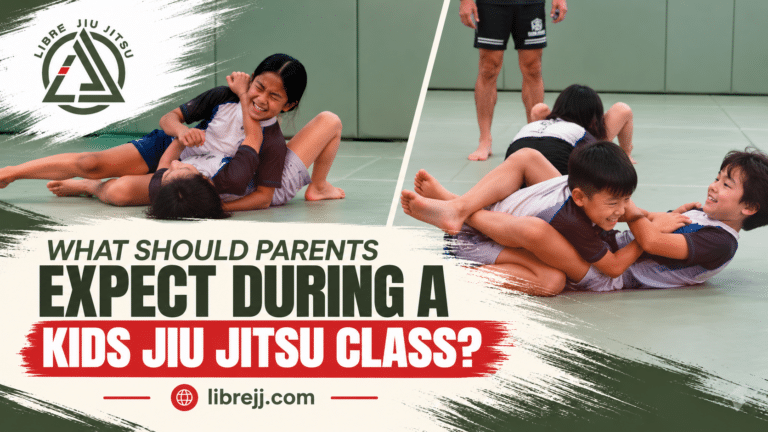
Some academies run programs for three and four year olds. They can be great, but you should know exactly what they are. At this age, a class is almost entirely play-based movement: animal walks, tumbling, tag-style games, coordination drills, and simple partner exercises. The goal is not technique. The goal is body awareness, listening to a coach who is not a parent, and building a positive association with the mat.
Here is the part most articles will not tell you: at three, most children are not learning “Brazilian Jiu Jitsu” in any real technical sense. They are learning to move. That is genuinely useful, but it is important to have realistic expectations. If your three year old is asking to try, and they can follow simple group instructions, go for it. If they are not there yet, waiting until four or five costs you nothing and often produces a faster, smoother start.
Signs a 3 to 4 year old is ready:
- They can follow a two step instruction.
- They can be away from a parent for thirty to forty five minutes.
- They enjoy physical play with other children.
- They are curious watching a class from the sideline.
If your child cries the whole first visit, that is not a “no forever.” It is often a “not this week.” A good academy will suggest coming back in a couple of months without any hard feelings.
Ages 5 to 7: The Common Starting Point
This is where most kids begin real jiu jitsu instruction, and there is a reason. By five, most children can sit through a forty five minute class, follow multi-step directions, and start absorbing basic positions. They are old enough to learn but young enough to build habits of respect, discipline, and body control before harder patterns set in.
What a class looks like at this stage:
- Warm-ups that combine movement games with foundational drills like shrimping and rolls
- Real fundamental positions: mount, guard, side control, and how to escape each
- Simple partner drills done slowly and cooperatively
- Positional games that make learning feel like play
- No striking, ever, and no rough or unsafe techniques
Kids who start at five or six often end up with remarkable coordination and body awareness by the time they are ten. That is not because they are “gifted.” It is because they got hundreds of hours of high-quality movement during a critical window for motor development. The belt and stripe system gives them clear, visible goals, which is powerful motivation for kids this age.
Ages 8 to 12: The Sweet Spot Nobody Talks About
Here is the part parents of older kids need to hear. If your child is between eight and twelve and has not started yet, this is arguably the best age to begin. Kids at this stage have the cognitive ability to actually understand technique, the body awareness to execute it, and the emotional maturity to handle winning, losing, and learning in front of peers.
What happens on the mat at this age:
- Kids stop just memorizing moves and start understanding why they work, including leverage, weight distribution, and how to chain one technique into the next
- Light, controlled positional sparring is introduced, which is where the deepest learning happens
- Both gi and no-gi training may be introduced
- The belt system gives them concrete goals to work toward, and the friendships get real
A quiet fact that surprises a lot of parents: kids who start at nine or ten often catch up to peers who started at five faster than you would expect, sometimes in a matter of months. The reason is cognitive. An eight year old can grasp a technical concept in one class that a five year old needs a month of repetition to absorb. If you have been worried you missed the window, you have not.
Ages 13 to 15: Teens Bring Their Own Advantages
Teenagers train differently, and that is good. They are physically stronger, more coordinated, more focused, and often motivated by something concrete like fitness, self-defense, or competition. A well-run teen class treats them more like young adults, with higher expectations and more technical depth.
Common concerns at this age:
- Feeling awkward as a beginner around younger kids who have been training for years. This lasts about six weeks. After that, older beginners typically progress faster than the younger longtimers.
- Balancing training with school and other activities. Two classes a week is a sustainable starting point.
- The social side. Teens tend to make friends fast on the mat because the shared struggle of learning something hard bonds people quickly.
Teens are also the age group where jiu jitsu can quietly become a life anchor. It is structured, it is disciplined, it builds real confidence, and it is a healthier outlet than most alternatives competing for a teenager’s attention.
Have I Missed the Window? An Honest Word for Parents of Older Kids
Short answer: no. There is no window that closes.
The longer answer is that different starting ages come with different advantages. A kid who starts at five will have the deepest reservoir of instinct and reps by the time they are a teenager. A kid who starts at ten will have a faster technical arc because their brain can absorb concepts more efficiently. A kid who starts at fourteen brings the strength, discipline, and focus of a young adult. None of those paths is better than the others, they’re just different.
If your child is nine, ten, or eleven and you have been putting it off, this is a great moment to start. Back-to-school time is actually one of the best entry points of the year: routines are resetting, kids are looking for their thing, and starting an activity in the fall means momentum by winter.
Kids Jiu Jitsu vs. Other Activities
Parents often ask how BJJ stacks up against soccer, karate, gymnastics, or wrestling. Here is the plain comparison, so you can decide what fits your child.
- Soccer and team sports: great for cardio, teamwork, and outdoor time. Playing time and skill development depend heavily on the team and the coach, and the season is short.
- Karate and taekwondo: teach coordination, discipline, and confidence, with more emphasis on kicks, punches, and forms. Good options for many kids, though the higher impact concerns some parents.
- Gymnastics: excellent for coordination and body control, but with higher fall-related injury risk and a narrower athletic ceiling for most kids.
- Wrestling: shares a lot with BJJ in terms of ground control and physicality, and it is a school-season sport. Great cross-training.
- Brazilian Jiu Jitsu: no strikes, no falls from height, year-round training, a belt system that keeps kids motivated for years, real self-defense skill, and a “second family” community. It also uniquely teaches a smaller child to control a larger one, which is empowering in a way few other sports match.
Nothing here is a knock on other sports. Many kids do BJJ alongside another sport and thrive.
What Safe, Age-Appropriate Training Actually Looks Like
Because jiu jitsu involves controlled physical contact, parents rightly want to know what safety looks like on the mat. If you want a deeper walkthrough of how injury risk compares to other youth sports and the safety features built into every well-run kids class, our full breakdown covers kids BJJ safety and what to look for at an academy in detail. The short version:
- No striking of any kind. No punches, no kicks.
- Slow, cooperative drilling. Kids practice at a controlled pace with supervised partners.
- The tap. If a child feels uncomfortable, they tap and their partner releases immediately, every single time.
- Banned techniques. Certain leg locks and neck cranks are off limits for kids at reputable academies.
- Constant supervision. A qualified coach is on the mat throughout the class.
The realistic injury profile for kids BJJ is minor: mat burns, a jammed finger, mild soreness. Serious injuries are rare, and the injury rate sits below the high-collision sports many kids already play.
How to Know a Program Is Right for Your Child’s Age
When you visit an academy (and you should visit before committing), look for:
- Age-grouped classes. A five year old and a twelve year old should not be in the same room. Their needs are totally different.
- The head coach teaching the kids classes, or at least visibly involved. If kids classes are always run by a random assistant, that tells you where they rank in the gym’s priorities.
- A small enough coach-to-kid ratio that no child spends the class waiting or unpaired. One coach per eight kids or better is a healthy target.
- A curriculum that progresses. Ask what your child would learn in month one, month three, and month six. A good coach can tell you.
- A clean mat, clear safety rules, and an ego-free culture. Kids should be learning respect and control, not competing to win at practice.
Ask to watch a full class before you sign anything. A confident program will always let you.
How Many Days a Week Should My Child Train?
For a first-time kid at any age, two classes a week is the sweet spot. It is enough to build real skill and consistency without overloading a busy family calendar. Three classes a week is great if your child loves it and wants more. Once a week can work, but progress will be slower, and building the habit is harder.
Many parents worry their child will “not want to go” after signing up. The single best predictor of a child sticking with it is a good first class experience, which is why a free trial is such a low-risk way to start. If your child comes out smiling, you have your answer.
Competitions, Belts, and What “Progress” Looks Like for a Kid
Parents often want to know what the path looks like a year or two in, once the child is past the first few classes. Here is the honest version so you can see the full arc.
The kids belt system
Kids progress through a colored belt system separate from adults, with intermediate colored stripes on each belt to mark shorter milestones. This structure is one of the quietly powerful features of jiu jitsu for children: each stripe is a specific, self-earned recognition of progress. It is not participation, and it is not seniority. It is real. Coaches watch for consistent attendance, effort, respect, and specific technical growth before awarding a stripe.
For a child, watching an instructor wrap a new stripe on their belt in front of the whole class is a moment that lands. It is one of the reliable motivators that carries kids through the first year, when the honeymoon of a new activity is starting to wear off.
Do kids have to compete?
No. Competition is completely optional at almost every reputable academy. Some kids love it and thrive on the challenge. Others prefer to train and never compete, and that is fine. A good coach reads the child and never pushes competition on a kid who does not want it.
For kids who do want to try, local tournaments give them a taste in a controlled setting, and they can decide from there. Competition tends to accelerate technical growth simply because it raises the stakes of what the child is drilling, but nothing about jiu jitsu requires it.
The two-year picture
For a kid who trains two classes a week consistently, here is a realistic two-year arc:
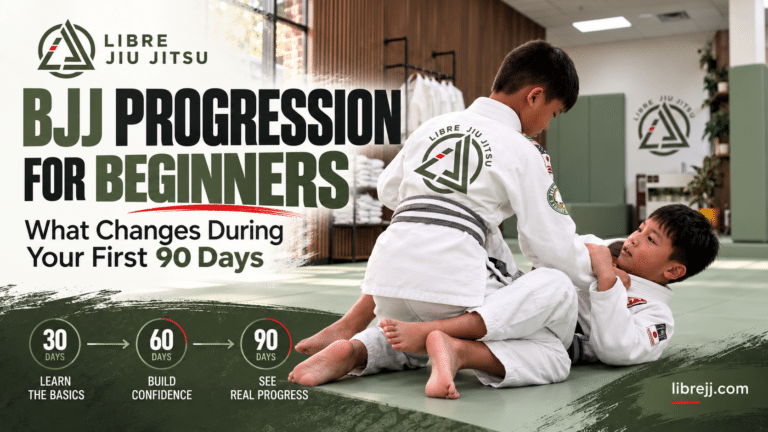
- Month 1 to 3: basic movement, fundamental positions, first stripe. Kids are still figuring out the culture.
- Month 3 to 6: techniques start to connect, real friendships form, and confidence becomes visible off the mat.
- Month 6 to 12: the first belt promotion for many kids, more advanced positions and escapes, and light controlled sparring as they mature into it.
- Year 2: the child is a confident member of the room, deeper technical understanding, potentially a second belt, and (importantly) the habit itself is now second nature.
None of that happens if they never walk through the door, which is exactly why we make the first week free: it is the low-friction on-ramp to a two-year arc that changes a lot about who a kid becomes.
Try It at Libre Jiu Jitsu in Farmers Branch
We run kids jiu jitsu classes grouped by age, with a curriculum built around the developmental stage your child is actually in. Whether you have a curious four year old, a ready-to-go seven year old, or a “did I miss the window” ten year old (you didn’t), there is a spot for them on the mat.
For families across Farmers Branch, North Dallas, Carrollton, and Addison, a few practical points:
- We are easy to reach and easy to park at, located at 13150 Senlac Drive, Farmers Branch, TX 75234, right off I-35E and Valley View Lane.
- Coaches teach kids classes directly, with real supervision and a real curriculum.
- The room is friendly, ego-free, and structured for how kids actually learn.
- You can check our weekly kids class times.
The smartest way to answer “is my child old enough” is to bring them and let them try it, with zero cost and zero pressure. We offer a free trial week for new students (a true free trial BJJ Dallas families can book with no commitment), or call us at 972-587-0488. When you decide to keep going, our flexible BJJ memberships include monthly, three-month, six-month. Bring them in and see. Book your child’s free week of kids classes at Libre Jiu Jitsu.
Frequently Asked Questions
What is the minimum age for kids jiu jitsu?
Most academies start at age five, some at four. Readiness matters more than the number: if your child can follow a simple instruction, share space, and take turns, they are likely ready.
Is my child too old to start BJJ at 9, 10, or 11?
No. Kids in this range often progress faster than younger beginners because they can grasp technique more quickly. Starting later is not a disadvantage, it is a different (and often more efficient) path.
Is jiu jitsu for four year olds a real class or just play?
At four, classes are largely play-based movement rather than formal technique. That is age-appropriate and useful, but if your child is not enjoying it, waiting until five is completely fine.
How many days a week should a kid start with?
Two classes a week is the sustainable sweet spot for a new student. Three works well if they love it and want more.
What is the youth BJJ ages breakdown?
Roughly: 3 to 4 is play and movement, 5 to 7 introduces fundamentals, 8 to 12 is the technical sweet spot with light sparring, and 13 to 15 begins to look like adult training with adjusted intensity.
How do I find kids jiu jitsu near me in Farmers Branch?
Libre Jiu Jitsu offers age-grouped classes and a free trial week. Reach out through Libre Jiu Jitsu or call 972-587-0488 to set it up, and you are welcome to watch the full class.