You watch your child try something new and physical, and a protective instinct kicks in. The first time you walk into a Brazilian Jiu Jitsu academy and see kids on the floor, pinning and wrestling and controlling each other, that instinct can spike. It looks intense. It can even look chaotic.
It is fair to ask the obvious question out loud: is jiu jitsu safe for kids? You deserve a straight answer, not marketing. So this guide gives you the honest picture: what the sport actually is, where the real risks are, the safety mechanisms built into every well-run class, how grappling compares to the sports your child may already play, and exactly what to look for (and what to walk away from) when you visit an academy.
At Libre Jiu Jitsu in Farmers Branch, right off I-35E and Valley View Lane, we run kids jiu jitsu classes that parents from North Dallas, Carrollton, and Addison trust with their children every week. If you have been searching for BJJ near me or Farmers Branch martial arts for your child and the safety question is what is holding you back, you can settle it yourself with a no-pressure free trial before committing to anything. Here is everything you need to make an informed decision.
The Short Answer
Yes. When it is taught properly at a reputable academy with age-appropriate classes, Brazilian Jiu Jitsu is one of the safest organized physical activities a child can do. It has a lower injury profile than most of the high-impact, high-collision youth sports that parents already consider normal.
The rest of this article is the long answer, because “trust me” is not good enough when it is your kid.
What Jiu Jitsu Actually Is (and What It Is Not)
To understand why BJJ is safe, you first have to understand what it is not. Unlike karate, taekwondo, boxing, or kickboxing, Brazilian Jiu Jitsu is a grappling art, not a striking art.
No Punching, No Kicking
In a real kids BJJ class there is absolutely no punching, kicking, or striking of any kind. That one fact changes the entire safety equation. The injuries that worry parents most in martial arts and contact sports, concussions and repeated head impacts, come from strikes and collisions. Remove the strikes, and you remove the single largest source of serious injury. Nobody is throwing a punch, so nobody is absorbing one.
Control, Not Violence
BJJ is built on leverage, position, and control rather than explosive force. A smaller child learns to use technique and angles to manage a larger partner. The guiding principle is position before submission, which means kids spend the overwhelming majority of their time learning to stabilize themselves and their partner safely on the ground, not throwing their bodies around. The goal of the art is to control a person, not to hurt them.
It Looks Like Structured Wrestling Plus PE
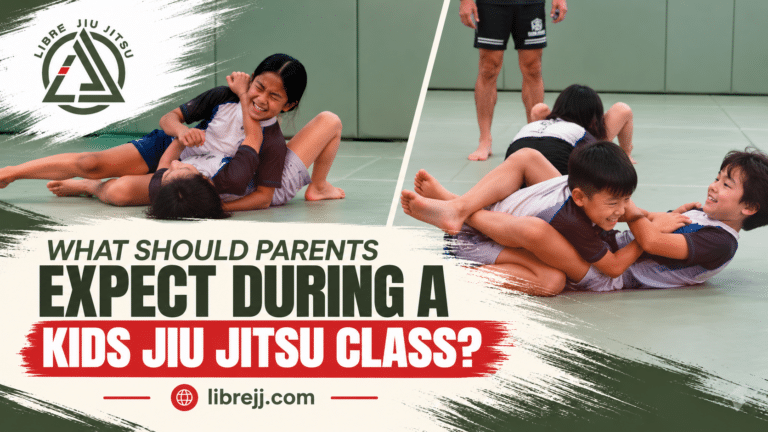
If you watched a well-run kids class without knowing what it was, you would see eight or ten children sitting in a line, listening to a coach demonstrate one movement, then pairing up to try it slowly while the coach circles the room correcting hands, hips, and angles. The picture in many parents’ heads (two grown adults in a cage) has nothing to do with what children actually do on the mat.
The Tap: The Built-In Safety Switch
The most important safety feature in Jiu Jitsu is also the one that teaches your child the most valuable life lesson. It is called tapping out.
If a child is caught in a hold, or simply feels uncomfortable, tired, or overwhelmed, they tap their partner or the mat two or three times (or say “tap”), and the partner stops immediately. Every single time. No exceptions.
For a parent, this is the key reassurance: the intensity of training can never exceed what your child is willing to handle, because your child controls the off switch. Beyond safety, the tap quietly teaches two things that matter for the rest of their life:
- Setting boundaries. Your child learns they have the right to stop a physical interaction instantly, with a clear signal.
- Respecting others’ boundaries. Your child learns to release the moment a partner taps, no questions asked.
Those are not small lessons. A kid who internalizes “I can say stop, and I must honor stop” carries that into the playground, the classroom, and far beyond.
The Honest Truth About Risk and Injuries
Let us be straight: BJJ is a contact sport. It involves physical struggle, resistance, and sweat. Any academy that promises zero risk is not being honest with you. But the injuries in grappling tend to look very different from the injuries in other sports, and they tend to be minor.
The Injuries That Actually Happen
In a well-run kids program, the realistic list is short:
- Mat burns, friction marks on knees and elbows, by far the most common
- Jammed or bumped fingers, usually from gripping a uniform wrong
- Mild muscle soreness, often from not warming up enough
- The occasional sore shoulder when a child forgets to tap promptly
Coming home tired with a small bruise is part of any active sport. Serious injuries are rare in youth programs because reputable academies prohibit the riskier techniques (certain leg locks and neck cranks) for children entirely, and because there are no strikes and no falls from height.
How It Compares to Sports Your Kid May Already Play
This is the comparison that puts it in perspective. Sports medicine research that looks at youth injury rates consistently places grappling arts below the high-impact, high-collision sports that families already accept as routine:
- Football and soccer involve high-speed collisions, sudden pivots that strain knees, and impacts between sprinting players.
- Basketball brings collisions, hard falls, and ankle and knee injuries from fast direction changes.
- Gymnastics and cheerleading involve falls and impacts from height.
In Jiu Jitsu, the action happens on the ground. There is no falling from a height, no sprinting collision, and movement happens at a pace where participants can usually see it coming. The realistic serious-injury risk in kids BJJ is roughly in the neighborhood of your child falling off their bicycle. That is the honest frame.
What Separates a Safe Gym From an Unsafe One
Here is the part most articles skip, and it matters more than the name of the martial art. The single biggest variable in your child’s safety is not the sport, it is the quality of the program. A well-run BJJ class is dramatically safer than a poorly run program in any sport. When you visit an academy, look for these specific things.
Green Flags (Signs of a Safe Program)
- The head instructor actually teaches the kids classes. Not only an assistant, not a teenage student earning mat time. If the head coach has not personally taught a kids class in months, that tells you what they think of the program.
- A low coach-to-kid ratio, ideally around one coach per eight children or better. Too many kids per coach means your child spends half the class waiting and gets paired with whoever is nearest, which is exactly where small injuries happen.
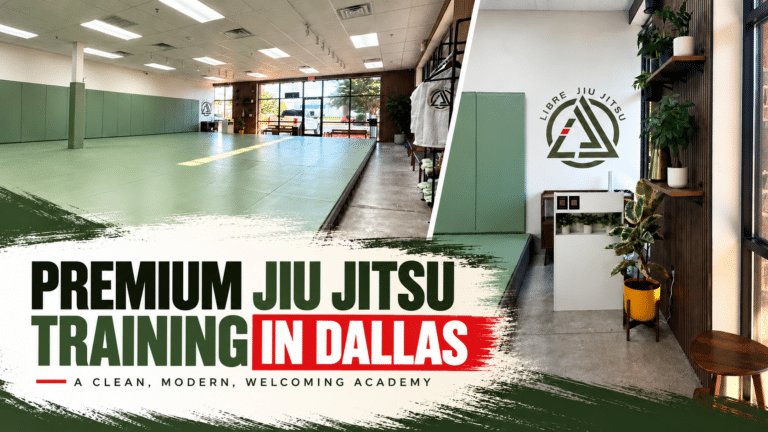
- Real mats. Walk on them. They should feel firm but with give. Thin, cheap foam is how kids end up sore.
- A structured, age-appropriate curriculum. Kids should progress through a planned sequence, not whatever the coach feels like that day.
- An explicit no-ego culture. The best single predictor of safety is whether the coach plainly tells kids that “beating” their drilling partner does not matter. Cooperation is the rule.
- Clear safety rules, including banned techniques for children and constant supervision during any sparring.
Red Flags (Reasons to Walk Away)
- Sparring that is unsupervised or looks like a free-for-all
- Coaches who let bigger or rougher kids dominate smaller ones
- A room that is visibly dirty, or mats that are never cleaned
- No introduction, no waiver, no questions about your child’s age or experience
- Pressure to sign a long contract before you have even watched a class
Trust your eyes and your gut. Ask to watch a full class before you commit to anything.
Is My Child Old Enough? The Real Readiness Test
Parents always ask about the minimum age, but the number on a sign-up sheet matters less than whether your child is developmentally ready. Most kids are ready around age five, some at four, some not until six or seven. Here is the practical checklist that actually predicts readiness. Can your child:
- Follow a thirty-second instruction from an adult who is not you?
- Share space with other children without melting down?
- Handle being told “wait” or “not yet” without a long meltdown?
- Take turns for a minute while another child practices?
If your child can do those four things, they are ready to start. Most preschool and early elementary kids can.
How Programs Are Usually Grouped by Age
Good academies separate kids into age-appropriate groups, because a five-year-old and a twelve-year-old need very different classes:
- Ages 3 to 4: play-based sessions focused on coordination, balance, listening, and basic movement. Mostly games, with very simple drills.
- Ages 5 to 7: real jiu jitsu fundamentals introduced at a gentle pace. Kids learn basic positions, escapes, and control. Discipline grows, but classes stay fun.
- Ages 8 to 12: the fuller curriculum, including controlled live rolling with peers, and an introduction to both gi and no-gi.
- Teens (13 and up): often bridge toward the adult program with adjusted intensity.
Gi vs No-Gi: A Quick Explainer for Parents
You will hear these two terms, so here is the plain version.
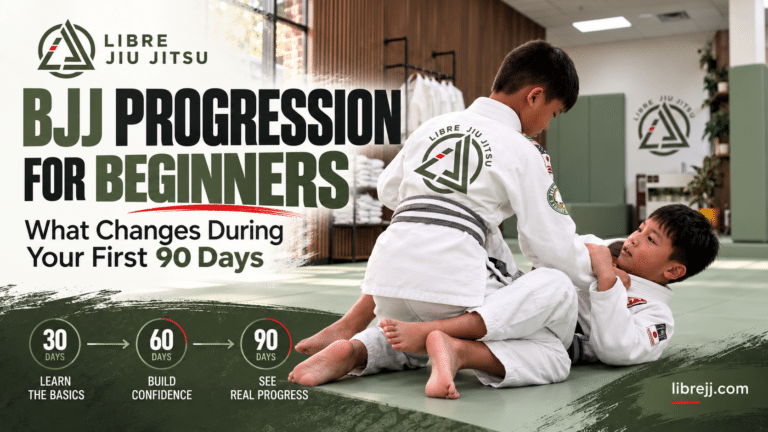
- Gi is the traditional uniform: a heavy cotton jacket, pants, and a colored belt. Practitioners grip the collar, sleeves, and pants. The pace is slower and more strategic because the grips give both kids more control.
- No-Gi is training in shorts and a rash guard (a snug athletic shirt). Without grips on clothing, the pace is a little faster and relies more on body control.
Most kids start in the gi because it teaches the fundamental control positions most clearly. By the eight-to-twelve range, many academies introduce both.
The Benefits That Make the Small Risks Worth It
Safety is the floor, not the reason most families stay. Here is what kids actually gain.
Real Protection Against Bullying
This is the number one reason many parents enroll their child, and the effect works on two levels:
- Physical preparedness. Bullying is almost always physical at close range: grabbing, shoving, pinning. BJJ is specifically the art of controlling close-range physical situations without throwing a punch, which is why parents looking into self-defense in Dallas for their kids land on it so often. It gives a trained child a genuine, practical advantage in the rare moment something escalates, and a way to defend themselves without hurting anyone.
- Posture and confidence. Bullies look for easy targets, kids who shrink, avoid eye contact, and look nervous. After a few months of consistent training, a child carries themselves differently. They stand taller and make eye contact, and that quiet confidence often stops a situation before it ever starts.
Physical Literacy and Safe Falling
The very first thing good academies teach is how to fall safely (breakfalling) and how to move on the ground without getting hurt. This “physical literacy” carries over to every other activity your child does, and it reduces injury risk in the rest of their athletic life too.
Discipline, Focus, and Emotional Regulation
A structured BJJ class asks a child to listen, wait their turn, control their body, and stay calm under mild pressure. Over months of consistent training, parents and teachers commonly report better focus, more patience, and steadier emotional regulation. Research on children who train martial arts consistently points to measurable gains in self-esteem and self-control over time.
It Will Not Make Your Child Aggressive
This is a common worry, and the reality is the opposite. Because BJJ has no striking and is built on control and respect, kids who train tend to become calmer and more secure, not more aggressive. A child who knows they can handle themselves has less to prove, not more. The mat culture explicitly rewards humility and self-control.
What a Typical Kids Class Looks Like
A class usually runs forty-five to sixty minutes and follows a predictable, calming structure:
- Warm-up (10 to 15 minutes): solo drills like shrimping, rolls, and animal movements. Kids learn to move without hurting themselves.
- Technique (15 to 25 minutes): the coach demonstrates a position, escape, or control, then kids pair up and drill it slowly.
- Positional games or controlled sparring (10 to 15 minutes): structured situations, like one child starting in a top position while the other practices escaping, always supervised.
- Line-up and cool-down (about 5 minutes): bowing out, sometimes a moment to recognize a child’s improvement.
The supervision is constant. The coach is on the mat the whole time, watching, correcting, and calling a stop the instant anything needs it.
A Quick Word on Cost
Pricing for kids programs varies by academy, location, and how many classes per week are included, and many gyms offer sibling or family discounts. The honest way to find the right plan for your child is to talk it through based on how often they will train. The best first step costs nothing, which brings us to the easy way to see all of this for yourself.
Common Myths About Kids Jiu Jitsu, Cleared Up
A lot of parental hesitation comes from a handful of myths that keep circulating. Here is the reality behind each.
“Jiu jitsu is too aggressive for kids.” It is the opposite. Because there is no striking and the whole art is about control and respect, the kids who train tend to become calmer and more self-assured. Aggression is not rewarded on the mat; control and composure are.
“My child is not athletic enough.” There is no athletic prerequisite. Coordination, balance, and conditioning are exactly what the classes build, starting from wherever your child is. The less naturally athletic kids often benefit the most, because they finally find a physical activity that meets them at their level.
“It is only for boys.” Plenty of girls train, and the leverage-based nature of the art means size and gender are not the deciding factors. Many academies have strong groups of girls who train and compete.
“They will get hurt.” Covered in detail above: the realistic injuries are mat burns and the occasional jammed finger, and the serious-injury risk sits below the high-impact sports many kids already play.
“My kid will not stick with it.” The belt and stripe progression gives children a visible, motivating sense of progress, and the friendships they form keep them coming back. A free trial is the low-risk way to find out before committing.
“My child is too young.” Many kids start around five, and readiness matters more than the exact age. The readiness checklist earlier in this article is a better guide than any number.
What to Ask When You Tour an Academy
Visiting in person is the best way to judge a program. Bring these questions, and watch how the staff answers them. A confident, safety-focused academy will welcome every one.
- Who teaches the kids classes, and is the head instructor involved?
- How many kids are in a class, and how many coaches are on the mat?
- How are children grouped by age and experience?
- How do you handle a child who is nervous or shy on their first day?
- Which techniques are off-limits for kids, and why?
- What does a typical class look like from start to finish?
- Can I watch a full class before signing up?
- Is there a free trial, and is there any commitment required to try it?
If the answers are clear and the staff seems genuinely focused on your child’s experience, that is a very good sign. If they dodge the safety questions or push you to sign a long contract before you have seen a class, keep looking.
See It With Your Own Eyes at Libre Jiu Jitsu
Reading about safety is useful. Watching a calm, well-run, supervised class with your own eyes is better. We built our kids program at Libre Jiu Jitsu around the exact green flags described above: coaches who teach the children directly, a structured age-appropriate curriculum, a clean mat, sensible group sizes, and a culture where ego is left at the door.
For families across Farmers Branch, North Dallas, Carrollton, and Addison, a few things make it easy:
- We are located right off I-35E and Valley View Lane, simple to reach with parking on site.
- Our kids classes are grouped by age so your child trains with peers at their level.
- Our coaches keep safety, supervision, and respect at the center of every class.
- You can check our weekly kids class times.
The smartest way to answer “is this right for my child?” is to come watch and let your child try it with no cost and no pressure. We offer a free trial week for new students (a real free trial BJJ Dallas families can book with no commitment). When you decide to continue, our flexible BJJ memberships include monthly, three-month, six-month, and yearly plans.
Book your child’s free week at Libre Jiu Jitsu and see a safe, structured class for yourself.
Frequently Asked Questions
Is jiu jitsu actually safe for young kids?
Yes, when taught at a reputable academy with age-appropriate classes and proper supervision. There is no striking, training is controlled, riskier techniques are banned for children, and the tap lets a child stop any uncomfortable situation instantly.
What is the most common injury in kids BJJ?
Mat burns (minor friction marks on knees and elbows) are the most common, followed by jammed fingers and mild soreness. Serious injuries are rare in well-run youth programs.
What age can my child start?
Many kids start around age five. Some are ready at four, some at six or seven. Readiness matters more than the exact number: if your child can follow a simple instruction, share space, and take turns, they are likely ready.
Will jiu jitsu make my child more aggressive?
No. Because it has no striking and is built on control and respect, BJJ tends to make kids calmer and more confident. A child who can handle themselves has less to prove.
Does it really help with bullying?
It helps on two levels: practical skill for close-range physical situations, and the confident posture that often keeps a child from being targeted in the first place.
How do I try a kids class in Farmers Branch?
Libre Jiu Jitsu offers a free trial week. Reach out through Libre Jiu Jitsu to set it up, and you are welcome to watch the full class.